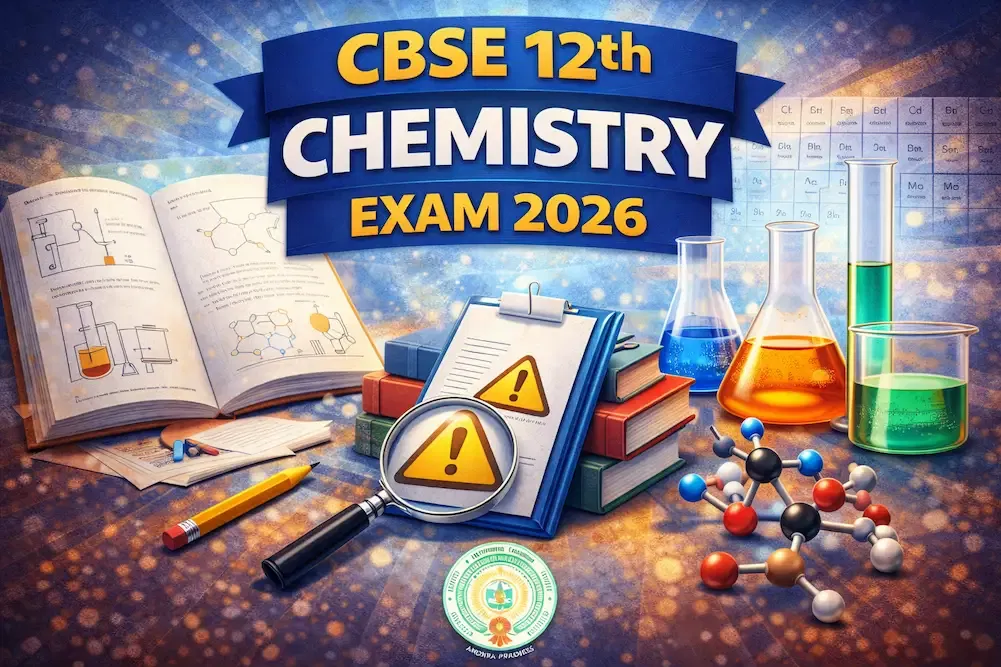
CBSE 12th Chemistry Exam Pattern 2026 – Check Marking Scheme
Table of Contents
The CBSE board has released the exam pattern for Class 12th Chemistry on its official website. The CBSE 12th Chemistry exam pattern 2025-26 explains the marking scheme of various sections in the Chemistry question paper, the types of questions in it, the marks allotted to different questions and sections, the weightage of all the different topics in the syllabus and the negative marking in the exam. The exam pattern helps you to know which type of questions come in the CBSE Class 12th exam 2026 and which chapter or unit requires the most attention. The exam pattern has been decided keeping the National Educational Policy (NEP) in mind, so that those topics are kept in focus that are more important for the board exams.
To properly study for the upcoming board exams, it is advised that you go over the CBSE 12th Exam Pattern 2026. It is important for you to know the CBSE 12th Chemistry exam pattern 2025-26 to study in a more organized manner and to give more time to the important topics. In order to use the exam pattern for your preparation, outline your study schedule according to the marking scheme of the different types of questions and the weightage. Various types of questions are covered in the CBSE 12th Chemistry question paper - both objective and subjective types. Also, there is no negative marking. Thus, the exam pattern will help you score more in the board exams.
The exam pattern is available on the official CBSE board website at cbse.gov.in. For those of you who will be sitting your 12th boards in the academic year 2025–2026, this post contains the CBSE 12th Chemistry exam pattern 2025-26.
Also read: CBSE class 12 Chemistry syllabus 2026
CBSE 12th Chemistry exam pattern 2026 - Section Wise
The CBSE 12th board exams are conducted for 100 marks out of which 70 marks are for the theory paper and 30 marks are for the practical.The Chemistry theory paper consists of five sections and has total marks of 70. There are 16 objective-type questions in Section A, each worth 1 mark, for a total of 16 marks. There are 5 short answer questions in Section B, each worth 2 marks, for a total of 10 marks. There are 7 short answer questions in Section C, each worth 3 marks, for a total of 21 marks. Section D contains 2 Case Study Based questions, each carrying 4 marks, totaling 8 marks. There are 3 long answer questions in Section E, each worth 5 marks, for a total of 15 marks. The exam has no negative marking. The following table elaborates the CBSE 12th Chemistry Exam Pattern 2026:
| Section | Number of questions | Marks Allotted |
|---|---|---|
| A | 16 | 1 mark for each question |
| B | 5 | 2 mark for each question |
| C | 7 | 3 marks for each question |
| D | 2 | 4 marks for each question |
| E | 3 | 5 marks for each question |
Also read: CBSE Class 12 Admit Card 2026
CBSE 12th Chemistry Marking Scheme 2026
The Marking Scheme of the various chapters from the Chemistry syllabus helps you to understand how you have to study for that particular chapter. The CBSE 12th Chemistry Marking Scheme 2026 is given in the following table:
| Sections | Type of Questions | Number of Questions | Marks Allotted |
|---|---|---|---|
| Solutions | Short answer type and Case Study Based questions | 2 | 7 |
| Electrochemistry | Objective, short answer type and long answer type questions | 3 | 9 |
| Chemical Kinetics | Objective and short answer type questions | 4 | 7 |
| The d and f-Block Elements | Objective and long answer type questions | 3 | 7 |
| Coordination Compounds | Objective, Short answer type and Case Study Based questions | 3 | 7 |
| Haloalkanes and Haloarenes | Objective and short answer type questions | 4 | 6 |
| Alcohols, Phenols and Ethers | Objective and short answer type questions | 3 | 6 |
| Aldehydes, Ketones and Carboxylic Acids | Objective and short answer type questions | 5 | 8 |
| Amines | Objective and long answer type questions | 2 | 6 |
| Biomolecules | Objective and short answer type questions | 4 | 7 |
| Total | 33 | 70 |
Also read: CBSE Class 12 sample papers
CBSE 12th Chemistry Unit Wise Marking Scheme 2026
The weight assigned to each unit in the CBSE 12th Chemistry syllabus varies. It is important for you to know the unit wise marking scheme of CBSE 12th Chemistry so that you can study accordingly. The CBSE 12th Chemistry unit wise marking scheme 2026 is given the table down below:
| Units | Weightage % | Marks Allotted |
|---|---|---|
| Solutions | 10% | 7 |
| Electrochemistry | 12% | 9 |
| Chemical Kinetics | 10% | 7 |
| The d and f-Block Elements | 10% | 7 |
| Coordination Compounds | 10% | 7 |
| Haloalkanes and Haloarenes | 9% | 6 |
| Alcohols, Phenols and Ethers | 9% | 6 |
| Aldehydes, Ketones and Carboxylic Acids | 11% | 8 |
| Amines | 9% | 6 |
| Biomolecules | 10% | 7 |
Also read: CBSE Class 12 Chemistry Deleted Syllabus 2026
How to use CBSE 12th Chemistry exam pattern 2026?
Understanding the CBSE 12th Chemistry exam pattern 2026 is important for you because by using it you can form your study schedule and practice smoothly for the board exams. You can use the CBSE 12th Chemistry exam pattern 2026 in the following ways:
- Check the types of questions that come from each chapter and practice the answers accordingly.
- Give more time to those chapters which have more marks allotted.
- Focus on the units with highest weightage.
- Try to write answers within the time allotted for the exam.
- If only objective type questions come from a chapter, don't waste your time practicing answer writing for it.
- Solve last year's question papers and sample papers.
You can visit this page frequently to get all the details related to CBSE 12th Chemistry Exam Pattern 2025-26 before giving the CBSE 12th board exams.
Explore Colleges In India VIEW ALL



![Motilal Nehru National Institute of Technology, [MNNIT] Allahabad](https://media.getmyuni.com/azure/college-image/small/motilal-nehru-national-institute-of-technology-mnnit-allahabad.webp)



Entrance Exams after 12th Boards