HPBOSE Class 10 Syllabus 2025-26 Released: Download Latest and Revised HPBOSE Class 10th Syllabus PDF with Subject-wise
The HPBOSE Class 10 Syllabus 2025-26 for all subjects is released. Students can download PDFs for Maths, Science, English, Social Science, and more. This syllabus helps identify key topics, understand the exam pattern, and prepare for the March 2026 board exams. It's crucial for effective preparation.
Table of Contents
HPBOSE 10th syllabus 2026 is available for subjects like Maths, Hindi, Science, English, and more. Students preparing for the HPBOSE 10th board exams should cover the entire syllabus for better exam preparation.
Analysing and getting familiar with the HPBOSE 10th 2026 syllabus will help you identify the essential topics for the upcoming board exams. Furthermore, with the help of the syllabus, you will know the HPBOSE 10th exam pattern 2026 for all the subjects.s
| HPBOSE 10th Question Paper 2026 | HPBOSE 10th Date Sheet 2026 |
HPBOSE 10th Syllabus 2026: Download PDFs
The board will conduct the HPBOSE 10th exam from March 2026 in pen and paper mode. Therefore, to stay prepared, students must use this updated HPBOSE 10th 2026 syllabus. The following table contains the PDF links for various subjects:
| Subjects | Syllabus PDF |
| Arts | Download |
| Commerce | Download |
| Computer Science | Download |
| Economics | Download |
| English | Download |
| Home Science | Download |
| Hindi | Download |
| Math | Download |
| Punjabi | Download |
| Science | Download |
| Social Science | Download |
| Sanskrit | Download |
| Urdu | Download |
HPBOSE 10th Subject-Wise Syllabus 2026 Details
Students can find the HPBOSE 10th syllabus 2026 for some subjects below. The students must analyse the syllabus as it will help them understand each topic's marking scheme.
HPBOSE 10th Syllabus 2026 for Maths
Maths includes the study of Arithmetical concepts, number systems, algebra, geometry, trigonometry,mensurations, statistics, graphs, coordinate geometry, etc. Find below the complete syllabus and the portions included for the HPBOSE 10th examination of the subject Maths.
Part I: Number system
- Real Numbers: Euclid's division lemma, Fundamental Theorem of Arithmetic-statements after reviewing work done earlier and after illustrating and motivating through examples, Proofs of results-irrationality, decimal expansions of rational numbers in terms of terminating / non-terminating recurring decimals.
Part II: Algebra
- Polynomials: Zeros of a polynomial. The relationship between zeros and coefficients of a polynomial with particular reference to quadratic polynomials. Statements and simple problems on the division algorithm for polynomials with real coefficients.
- Pair of Linear Equations in Two Variables: Pair of linear equations in two variables. Geometric representation of different possibilities of solutions' inconsistency. Algebraic conditions for the number of solutions. The solution of the pair of linear equations in two variables obtained algebraically by substitution, by elimination, and by cross multiplication. Simple situational problems must be included. Simple problems on equations reducible to linear equations may be included.
- Quadratic Equations: Standard form of a quadratic equation ax² + Bx + c = 0. The solution of the quadratic equations (only real roots) by factorisation and by completing the square, i.e by using the quadratic formula. A relationship between the discriminant and the nature of the roots. Problems related to day-to-day activities to be incorporated.
- Arithmetic Progression: The motivation for studying AP. Derivation of standard results of finding the nth term and the sum of the first n terms.
Part III: Trigonometry
- Trigonometric Ratios: Trigonometric ratios of an acute angle of a right-angled triangle. Proof of their existence (well defined); motivate the ratios, whichever are defined at 0° & 90°. Values (with proofs) of the trigonometric ratios of 30°, 45° & 60°. Relationships between the ratios.
- Trigonometric Identities: Proofs and applications of the identity sin2 A + cos2 A = 1. Only simple identities to be given. Trigonometric ratios of complementary angles.
- Heights and Distances: Simple and believable problems on heights and distances. Problems should not involve more than two right triangles. Angles of elevation/depression should be only 30°, 45°, 60°.
Part IV: Coordinate Geometry
- Lines (In two dimensions): Review the concepts of coordinate geometry done earlier, including graphs of linear equations. Awareness of the geometrical representation of quadratic polynomials. The distance between two points and the section formula (internal). Area of a triangle.
Part V: Geometry
- Triangles
- (Prove) If a line a drawn parallel to one side of a triangle to intersect the other two sides in distinct points, the other two sides are divided in the same ratio.
- (Motivate) If a line divides two sides of a triangle in the same ratio, the line is parallel to the third side.
- (Motivate) If in two triangles, the corresponding angles are equal, their corresponding sides are proportional and the triangles are similar. (Motivate) If the corresponding sides of two triangles are proportional, their corresponding angles are equal and the two triangles are similar. (Motivate) If one angle of a triangle is equal to one angle of another triangle and the sides including these angles are proportional, the two triangles a, re similar.
- (Motivate) If a perpendicular is drawn from the vertex of the right angle of a right triangle to the hypotenuse, the triangles o,,n each side of the perpendicular are similar to the whole triangle and each other.
- (Prove) The ratio of the areas of two similar triangles is equal to the ratio of the squares on their corresponding sides.
- (Prove) In a right triangle, the square on the hypotenuse is equal to the sum of the squares on the other two sides.
- (Prove) In a triangle, if the square on one side is equal to the sum of the squares on the other two sides, the angle opposite to the first side is a right angle
- Circles: (Prove) The tangent at any point of a circle is perpendicular to the radius through the point of contact. (Prove) The lengths of tangents drawn from an external point to a circle are equal.
- Constructions: Division of a line segment in a given ratio (internally), Tangent to a circle from a point outside it. Construction of a triangle similar to a given triangle.
Part VI: Mensuration
- Areas of Plane Figures: Motivate the area of a circle; area of sectors and segments of a circle. Problems based on areas and perimeter/ circumference of the above-mentioned plane figures. (In calculating an area of the segment of a circle, problems should be restricted to a central angle of 60°, 90° & 120° only. Plane figures involving triangles, simple quadrilaterals, and circles should be taken.
- Surface Areas and Volumes: Problems with finding surface areas and volumes of combinations of any two of the following cubes, cuboids, spheres, hemispheres, and right circular cylinders/cones. Frustum of a cone. Problems involving converting one type of metallic solid into another, and other mixed problems. (Problems with a combination of not more than two different solids should be taken.
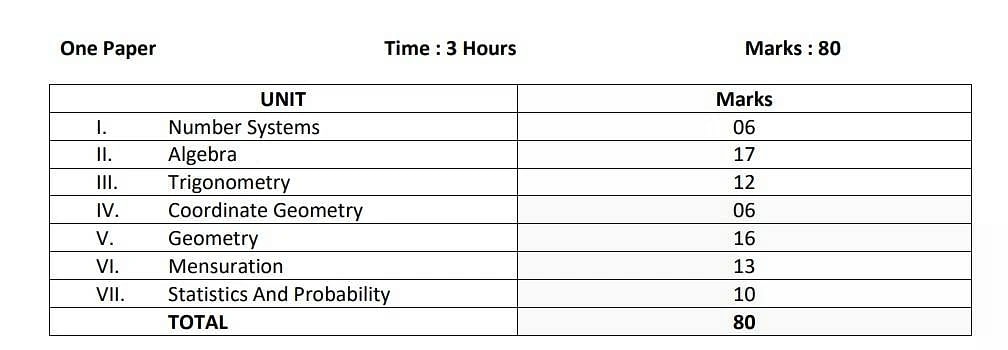
Refer to the image mentioned below to understand the HOBOSE 10th syllabus 2026 unit-wise marking scheme.
The prescribed books for HPBOSE 10th Maths are also given below for the students' reference.
| Ganit | Published by H.P. Board of School Education |
HPBOSE 10th Syllabus for Science & Technology
Find below the complete HPBOSE 10th syllabus 2026 for the Science and Technology theory examination. The subject gives an insight into different topics like Food, Materials, the World of the Living, How things Work, Moving Things, People and Ideas, Natural phenomena and Natural Resources.
Part 1: Chemical Substances
- Acids, bases, and salts: General properties, examples, and uses. Chemical reactions: Types of chemical reactions: combination, decomposition, displacement, double displacement, precipitationeutralisationion, oxidation, and reduction in terms of gain and loss of oxygen and hydrogen. Metals and non-metals: Brief discussion of basic metallurgical processes. Properties of common metals. The elementary idea about bonding.
Part 2: Carbon Compounds
- Carbon compounds, an elementary idea about bonding. Saturated hydrocarbons, alcohol, and carboxylic acids (no preparation, only properties). Some important chemical compounds: Soap-cleansing action of soap. Periodic classification of elements: Gradations in properties: Mendeleev periodic table.
Part 3: Our Environment
- Our environment: Environmental problems, their solutions. Biodegradable, non-biodegradable, and ozone depletion. Life Processes: ''living" things; the Basic concepts of nutrition, respiration, transport, and excretion in plants and animals. Control and Co-ordination in plants and animals: Tropic movements in plants; Introduction to plant hormones; control and co-ordination in animals; voluntary, involuntary and reflex action, nervous system; chemical coordination: animal hormones.
Part 4: Reproduction
- Reproduction in plants and animals. Need for and methods of family planning. Safe sex vs HIV/AIDS. Childbearing and women's health. Heredity and evolution: Heredity; Origin of life: brief introduction; Basic concepts of evolution.
Part 5: Effects of Current
- Potential, Potential difference, Ohm's law; Series combination of resistors, the parallel combination of resistors; Power dissipation due to current; Interrelation between P, V, I and R.Magnets: Magnetic field, field lines, field due to a current-carrying wire, field due to current-carrying coil or solenoid; Force on the current-carrying conductor, Fleming's left-hand rule. Electromagnetic induction. The induced potential difference, Induced current. Direct current. Alternating current; frequency of AC. The advantage of AC over DC. Domestic electric circuits.
Part 6: Convergence and Divergence of Light
- Images formed by a concave mirror; related concepts; a centre of curvature; principal axis. Optic centre focus, focal length. Refraction: laws of refraction. An image formed by a convex lens; Functioning of a lens in the human eye; problems of vision and remedies. Applications of spherical mirrors and lenses. Appreciations of a concept of refraction: the velocity of light, refractive index. A twinkling of stars; dispersion of light. Scattering of light.
Part 7: Conservation of Natural Resources
- Management of natural resources. Conservation and judicious use of natural resources. Forest and wildlife, coal, and petroleum conservation. People's participation. Chipko movement. Legal perspectives in conservation and international scenarios. Regional environment: Big dams; advantages and limitations; alternatives, if any. Water harvesting. Sustainability of natural resources.Sources of energy: Different forms of energy, leading to different sources for human use: fossil fuels, solar energy, biogas, wind, water, tidal energy, and nuclear energy. Renewable versus non-renewable sources.
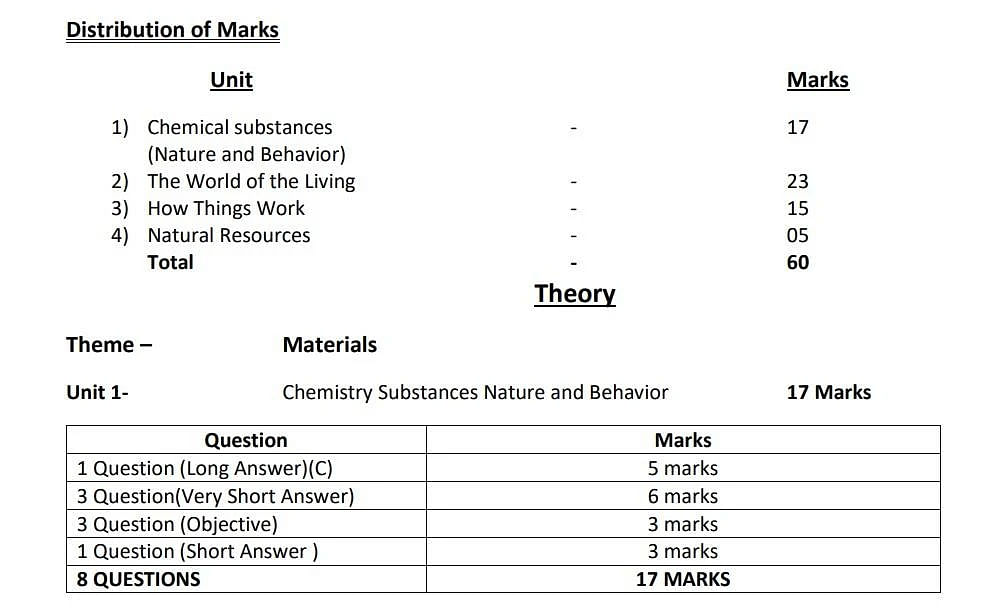
Refer to the image mentioned below to understand the HPBOSE 10th syllabus 2026 Science pattern.
The prescribed books for HPBOSE 10th Science are also given below for the students' reference.
| Vigyan | Published by the H.P. Board of School Education. |
HPBOSE 10th Syllabus 2026 for English
Find below the complete HPBOSE 10th syllabus for the English examination of the year 2026.
| Sections | Content | Marks |
| Reading |
|
17 |
| Writing |
|
18 |
| Grammar |
|
15 |
The prescribed book for the English HPBOSE 10th syllabus 2026 is given below for students' reference.
| First Flight | Published by the H.P.. Board of School Education |
| Footprints Without Feet | Published by H.P.. Board of School Education |
HPBOSE 10th Syllabus 2026 for Social Science
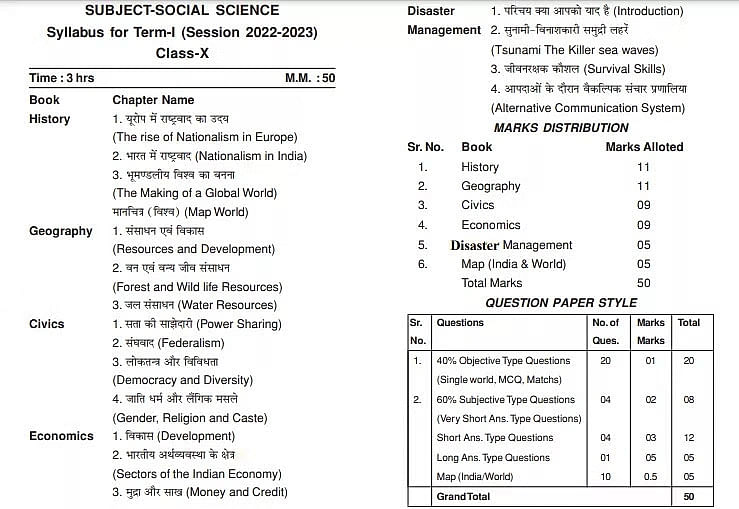
Social Science consists of theory papers, and to score a higher grade, students must revise them thoroughly. The chapters and topics are mainly from sections like geography, history, civics, and economics, cs with some elements from sociology and commerce. Refer to the image mentioned below to understand the topic-wise marks for the Social Science subject.
The prescribed books for the HPBOSE 10th syllabus 2026 Social Science are given below for the students' reference.
| Unit-1 India and the Contemporary World | Published by H.P. Board of School Education |
| Unit 2 India- Resources and their Development Unit | Published by H.P. Board of School Education |
| Unit -3 Democratic Politics II | Published by H.P. Board of School Education |
| Unit-4 Understanding Economics-II | Published by H.P. Board of School Education |
| Unit-5 Disaster Management | Published by H.P. Board of School Education |
HPBOSE 10th Syllabus 2026 for Health Education and Physics
Find below the complete HPBOSE 10th syllabus for Health Education and Physics.
Athletics
- Running Events - Sprints (including hurdles) and middle and long-distance events.. Emphasis is to be laid on correct starting and finishing techniques, running action, including foot plantation and body carriage. Jumping Events-Consolidation of shot put and discus throw techniques and an introduction to the fundamentals of javelin and hammer throw. Participation in exercise schedules for improving different motor components, namely speed, strength, endurance, flexibility, and coordinative abilities.
Note: (i) At this stage, the student has to aim for his performance attainment, and hence he should select one event for specialisation. More than one event can be chosen only if a logical relationship exists between them. (ii) Introduction of basic rules related to the events.
Gymnastics
- Boys: (a) Repetition of previously learned skills. (b) Skills (floor Exercises) Head Spring round of (c) Vaulting Horse Straddle vault on broad horse handspring on a broad horse, Take off and sitting on the long horse. Straddle from the standing position on long horse (d). Parallel bars. Different kinds of mounts and dismounts. One bar roll Shoulder stand 'L' position hold (e) Horizontal Bar Different types of grips. Back turn over one leg circle forward Simple swing
- Girls: (a) Repetition of skills learned in the previous class (b) Skills (Floor exercises). One hand cartwheel, eel, Round off (c), Balancing Beam, Dancing movements, Running movement,,s Front roll and back roll, Different balances (d), Vaulting Horse, Straddle vault on broad horse, Wolf vault (sidvaultt, e catat springs and jumps on a long horse.
Yoga
- Dhanurasana, Kukutasana, Mayurasana, Suptavajrasana, Vakasana, Gaumukhasana, Supt-Pawan, Muktasana, Halasanal, Shalabhasana, Naukasana, Shirshasana, Surya Namaskar
Major Games
-
Cricket, Football, Hockey, Basketball, Volleyball, Handball, Kho-KhoKabaddi, Table Tennis, Badminton, Wrestling, Judo
Note: Emphasis is to be laid on the consolidation of technique and learning of basic tactical patterns. These games are played in full-size fields, if available. In case only a small play area is available, these games are played in a modified form. Participation in exercise schedules for improving different motor components, namely speed, strength, endurance, flexibility, and coordinative abilities.Introduction of basic rules related to the games.
Swimming
-
Emphasis is to be laid on the consolidation of techniques of all strikes and learning of basic tactical patterns, using competitive distances. Participation in exercise schedules for improving different motor components related to swimming. Consolidation of water polo skills and dives.Introduction to basic rules of swimming, water polo, and diving.
Note: At this stage, the student has to aim for high-performance attainment, and hence he should select one event for specialisation. More than one event can be chosen only if logical. al
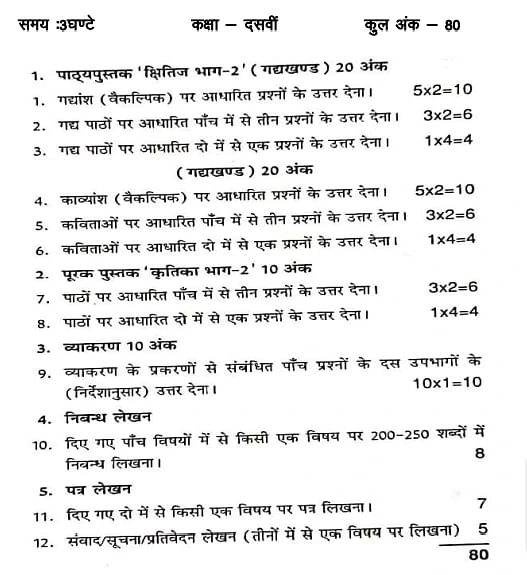
HPBOSE 10th Syllabus 2026 for Hindi
Find below the complete details of the HPBOSE 10th syllabus 2026 for Hindi.
FAQs on HPBOSE 10th Syllabus
Q: Is HP board syllabus reduced?
Q: Has the HPBOSE 10th syllabus for 2026 been released?
Q: Are questions asked in HPBOSE 10th board exam entirely based on HPBOSE 10th syllabus?
Q: What is the passing marks for HP board 2026?