BSEB Class 12 History Latest Syllabus 2025-26: Download Latest and Revised BSEB Class 12th History Syllabus PDF
The Bihar Board Class 12 History syllabus for 2025-26 has three parts: Ancient (25 marks), Medieval (30 marks), and Modern India (45 marks). The 100-mark exam requires 30% to pass. Students must analyze topics like Harappan Civilisation and Bhakti-Sufi Traditions for effective preparation.
Table of Contents
The Bihar Board class 12th History syllabus 2025-26 contains three parts, including chapters such as Harappan Civilisation. Early States and Economies, Early Societies, Cultural Developments, Traveller Accounts, Bhakti-Sufi Traditions, Vijayanagara Capital, and more.
The BSEB Board will conduct the Bihar Board 12th exam 2026 History paper for 100 marks, and students must score at least 30 per cent to pass the exam. Before starting the exam preparation, you must analyse and understand all the topics and the marks distribution.
Bihar Board 12th History Syllabus 2026: Details
The BSEB 12th History syllabus 2025-26 is divided into three parts. Part I carries 25 marks and consists of topics like Ancient Indian History. Similarly, part II has 30 marks and consists of the issues of Medieval India, and part III carries 45 marks, which contains Modern India. The detailed Bihar Board Class 12 history syllabus in Hindi is given below for the students' reference.
Bihar Board 12th History 2025-26 Syllabus: Part I
Part I of the Class 12th History syllabus of the Bihar Board is given below for your reference.
| Units | Marks |
| Unit 1 The Story of the First Cities: Harappan Archaeology | 34 |
| Unit 2: Political and Economic History: How Inscriptions tell a story | |
| Unit 3: Social Histories: Using the Mahabharata | |
| Unit 4: A History of Buddhism: Sanchi Stupa |
Bihar Board Class 12 History 2025-26 Syllabus: Part II
Part II of the BSEB 12th History syllabus is mentioned below for your reference.
| Units | Marks |
| Unit 5: Medieval Society through Travellers’ Accounts |
25 |
| Unit 6: Religious Histories: The Bhakti-Sufi Tradition | |
| Unit 7: New Architecture: Hampi | |
| Unit 8: Agrarian Relations: The Ain-i-Akbari | |
| Unit 9: The Mughal Court: Reconstructing Histories through Chronicles |
Bihar Board Class 12th History 2025-26 Syllabus: Part III
The Bihar Board History Syllabus Class 12 Part III is mentioned below for your reference.
| Units | Marks |
| Unit 10: Colonialism and Rural Society: Evidence from Official Reports | 25 |
| Unit 11: Representations of 1857 | |
| Unit 12: Colonialism and Indian Towns: Town Plans and Municipal Reports | |
| Unit 13: Mahatma Gandhi Through Contemporary Eyes | |
| Unit 14: Partition through Oral Sources | |
| Unit 15: The Making of the Constitution |
Also Read: BSEB 12th Previous Year Question Papers
BSEB 12th History Syllabus 2025-26: Chapter-Wise Details
Students must go through the entire syllabus, marking scheme, and BSEB 12th exam pattern. Moreover, the chapter-wise details and the learning outcome of the Bihar Board 12th History syllabus 2025-26 are tabulated below.
Unit I: The Story of the First Cities: Harappan Archaeology.
- Broad overview: Early urban centres.
- Story of discovery: Harappan civilisation.
- Excerpt: Archaeological report on a major site
- Discussion: How has it been utilised by archaeologists/historians?
Unit II: Political and Economic History: How Inscriptions tell a story.
- Broad overview: Political and economic history from the Mauryan to the Gupta period.
- Story of discovery: Inscriptions and the decipherment of the script. Shifts in the understanding of political and economic history.
- Excerpt: Asokan inscription and Gupta period land grant.
- Discussion: Interpretation of inscriptions by historians.
Unit III: Social Histories: Using the Mahabharata
- Broad overview: Issues in social history, including caste, class, kinship, and gender.
- Story of discovery: Transmission and publications of the Mahabharata.
- Excerpt: from the Mahabharata, illustrating how it has been used by historians.
- Discussion: Other sources for reconstructing social history.
Unit IV: A History of Buddhism: Sanchi Stupa
- Broad overview: A brief review of the religious histories of Vedic religion, Jainism, Vaishnavism, and Shaivism (Puranic Hinduism). Focus on Buddhism.
- Story of discovery: Sanchi stupa
- Excerpt: Reproduction of sculptures from Sanchi.
- Discussion: Ways in which sculpture has been interpreted by historians and other sources for reconstructing the history of Buddhism.
Unit V: Medieval Society through Travellers' Accounts
- Broad overview: Outline of social and cultural life as it appears in travellers' accounts.
- Story of their writings: A discussion of where they travelled, why they travelled, what they wrote, and for whom they wrote.
- Excerpts: from Al-Biruni, Ibn Battuta, and Francois Bernier
- Discussion: What these travel accounts can tell us and how they have been interpreted by historians?
Unit VI: Religious Histories: The Bhakti-Sufi Tradition
- Broad overview: Outline of religious developments during this period, Ideas and practices of the Bhakti-Sufi saints
- Story of Transmission: How Bhakti-Sufi compositions have been preserved.
- Excerpt: Extracts from selected Bhakti-Sufi works
- Discussion: Ways in which these have been interpreted by historians.
Unit VII: New Architecture: Hampi
- Broad overview: Outline of new buildings during the Vijayanagar period, temples, forts, irrigation facilities, and the Relationship between architecture and the political system
- Story of Discovery: Account of how Hampi was found.
- Excerpt: Visuals of buildings at Hampi
- Discussion: Ways in which historians have analysed and interpreted these structures.
Unit I: Agrarian Relations: The Ain-i-Akbari
- Broad overview: Structure of agrarian relations in the
16thand 17thcenturies. Patterns of change over the period - Story of Discovery: Account of the compilation and translation of Ain-i-Akbari
- Excerpt: from the Ain-i-Akbari
- Discussion: Ways in which historians have used the text to reconstruct history.
Unit VIII: The Mughal Court: Reconstructing Histories through Chronicles
- Broad overview: Outline of political history, 15th-17th
centuries, Discussion of the Mughal court and politics - Story of Discovery: Account of the production of court chronicles, and their subsequent translation and transmission.
- Excerpts: From the Akbarnama and Padshahnama
- Discussion: Ways in which historians have used the texts to reconstruct political histories.
Unit IX: Colonialism and Rural Society: Evidence from Official Reports
- Broad overview: Life of Zamindars, peasants, and
artisans in the late 18th century, East India Company, revenue settlements in various regions of India, and surveys, Changes over the nineteenth century - Story of official records: An account of why official investigations into rural societies were undertaken and the types of records and reports produced.
- Excerpts: From Fifth Report, Accounts of Frances Buchanan-Hamilton, and Deccan Riots Report.
- Discussion: What do the official records tell and do not tell, and how have they been used by historians?
Unit X: Representations of 1857
- Broad overview: The events of 1857-58, Vision of Unity, and how these events were recorded and narrated.
- Focus: Lucknow
- Excerpts: Pictures of 1857. Extracts from contemporary accounts
- Discussion: How the pictures of 1857 shaped British opinion of what had happened.
Unit XI: Colonialism and Indian Towns: Town Plans and Municipal Reports
- Broad overview: History of towns in India, colonisation and cities, hill stations, town planning of Madras, Calcutta, and Bombay.
- Excerpts: Photographs and paintings. Plans of cities. Extract from town plan reports. Focus on Calcutta town planning.
- Discussion: How can the above sources be used to reconstruct the history of towns? What these sources do not reveal.
Unit XII: Mahatma Gandhi Through Contemporary Eyes
- Broad overview: The Nationalist Movement 1918 -48, The nature of Gandhian politics and leadership.
- Focus: Mahatma Gandhi and the three movements and his last days as “finest hours”
- Excerpts: Reports from English and Indian language newspapers and other contemporary writings.
- Discussion: How newspapers can be a source of history.
Unit XIII: Partition through Oral Sources
- Broad Overview: The history of the 1940s, Nationalism, Communalism and Partition.
- Focus: Punjab and Bengal
- Excerpts: Oral testimonies of those who experienced partition.
- Discussion: Ways in which these have been analysed to reconstruct the history of the event.
Unit XIV: The Making of the Constitution
- Broad overview: Independence and the new nation-state, The making of the constitution
- Focus: The Constitutional Assembly debates
- Excerpts from the debates
- Discussion: What do such debates reveal and how can they be analysed?
BSEB Class 12th History Syllabus 2025-26: Individual Assessment
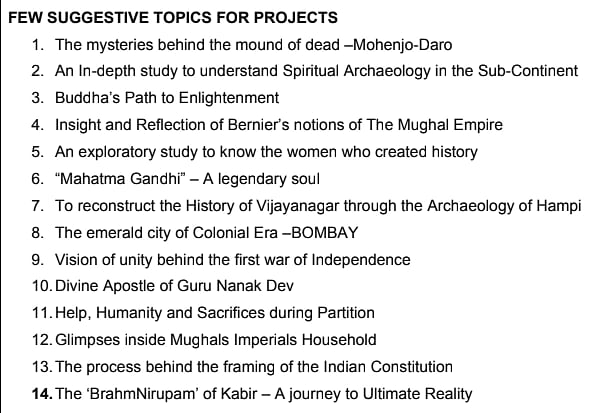
The Bihar board 12th History syllabus 2025-26 consists of 20 20-mark project. It will help the students to develop the skill to gather data from various sources and investigate diverse viewpoints. Moreover, the school authorities will conduct the individual assessment. The marks will be allocated under the following heads:
| Particulars | Marks |
| Project Synopsis | 2 Marks |
| Timeline/explanation and interpretation/Map work | 5 Marks |
| Visual/overall presentation | 4 Marks |
| Analysis/ Data/Statistical analysis | 4 Marks |
| Bibliography | 1 Mark |
| Viva | 4 Marks |
| Total | 20 Marks |
Refer to the image below for a detailed BSEB 12th History project.
Bihar Board 12th History Syllabus: PDF Download
Students can download the Class 12 History syllabus of the Bihar Board in PDF format. All the marking schemes and unit-wise mark distributions are given in the PDF. Moreover, after completing the syllabus, students are also encouraged to use the BSEB 12th sample paper, which will help them strengthen their preparation.
| Particulars | PDF Link |
| Bihar Board 12th History Syllabus | Download Now |
Prescribed Books for Class 12 History Syllabus Bihar Board 2025-26
Students must use the BSEB 12th books to strengthen their base, as they include all the essential topics and guidelines. Some suggested book lists are below for the students' reference.

Also Read: Bihar Board 12th Books 2025-26
Explore Top Colleges In Bihar VIEW ALL







Entrance Exams after 12th Boards