BSEB 12th Chemistry Exam Pattern 2025-26 - Check Marking Scheme
Table of Contents
The Bihar School Examination Board (BSEB) will be releasing the BSEB 12th Chemistry Exam Pattern on the official website of BSEB at biharboardonline.bihar.gov.in. The chemistry exam will be conducted for 100 marks, with 70 marks allocated to theory and 30 marks to practicals. You should at least get 30% in each subject to pass the BSEB Class 12th exam 2026.
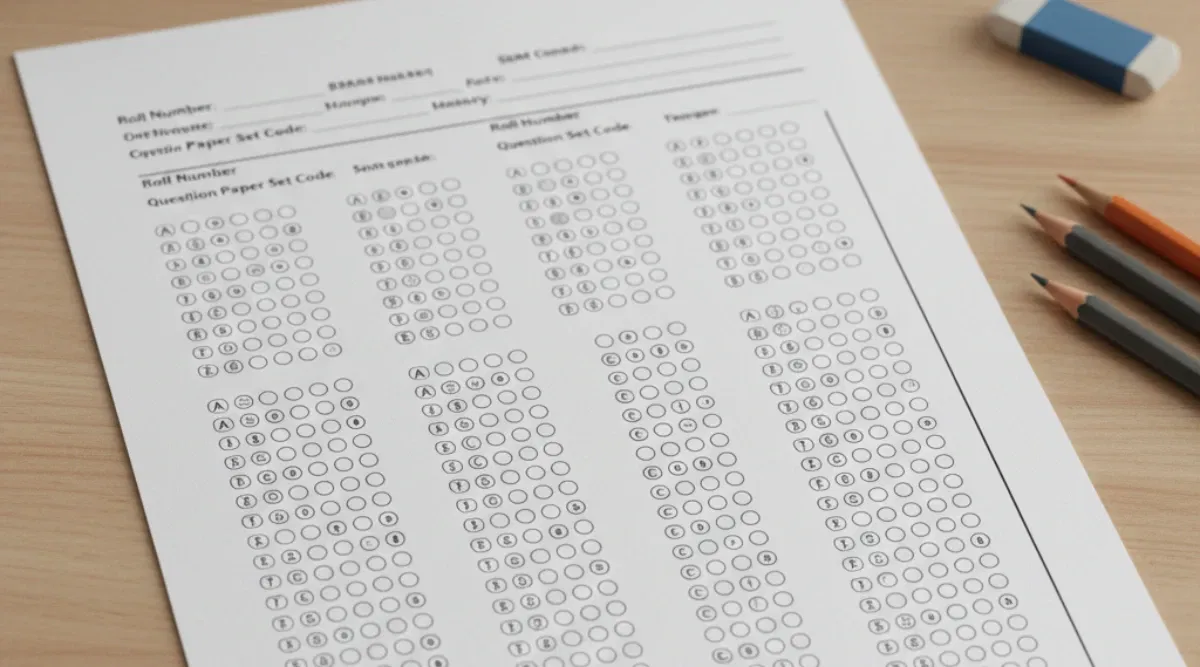
In accordance with the BSEB 12th Exam Pattern 2026, the theory paper will contain two sections, A and B. Section A will contain objective-type questions worth 35 marks, and Section B will contain long-answer-type and short-answer-type questions also worth 35 marks. As a result, the total for the paper will be 70 marks.
The article below provides all information about the Bihar Board Chemistry Question Pattern 2026, such as the marking scheme and weightage for all subjects, and a few other updates.
BSEB 12th Chemistry Exam Pattern 2026 - Section Wise
The Bihar School Examination Board (BSEB) Class 12 Chemistry Exam 2026 will be worth 70 marks and will include 96 questions divided into two sections. You must answer a total of 48 questions as specified. More Details regarding the BSEB 12th Chemistry Section Wise Pattern can be checked below:
|
Section |
Number of Questions |
Marks Allotted |
|
|
Section A |
35 questions need to be answered out of 70 questions (objective-type questions) |
35 x 1 = 35 |
|
|
Section B |
10 questions need to be answered out of 20 (short-answer-type questions) |
10 x 2 = 20 |
|
|
3 questions need to be answered out of 6 (long-answer-type questions) |
3 x 5 = 15 |
||
|
Total Marks |
70
|
||
Also Read: Bihar Board 12th Previous Year Question Papers
BSEB 12th Chemistry Marking Scheme 2026
Understanding the distribution of marks among units in the BSEB 12th Chemistry exams is important for you, as it allows you to plan your study according to the weightage assigned to each subject and focus more on subjects that have high weightage. BSEB 12th Chemistry theory paper consists of 16 units/units of Chemistry, including p-block Elements (8 marks) and Aldehydes, Ketones, and Carboxylic Acids (6 marks) with the most weightage, while units like General Principles and Processes of Elements Isolation, Coordination Compounds, Polymers, and Chemistry in Everyday Life with 3 marks each. Other unit marks distribution for BSEB 12th Chemistry paper has been mentioned in the table below.
|
Unit |
Chapters |
Marks |
|
Unit 1 |
Unit 1: Solid State |
04 |
|
Unit 2 |
Unit 2: Solutions |
05 |
|
Unit 3 |
Unit 3: Electrochemistry |
05 |
|
Unit 4 |
Unit 4: Chemical Kinetics |
05 |
|
Unit 5 |
Unit 5: Surface Chemistry |
04 |
|
Unit 6 |
Unit 6: General Principles and Processes of Isolation of Elements |
03 |
|
Unit 7 |
Unit 7: p-block Elements |
08 |
|
Unit 8 |
Unit 8: d and f-block elements |
05 |
|
Unit 9 |
Unit 9: Coordination Compounds |
03 |
|
Unit 10 |
Unit 10: Haloalkanes and Haloarenes |
04 |
|
Unit 11 |
Unit 11: Alcohols, Phenols, and Ethers |
04 |
|
Unit 12 |
Unit 12: Aldehydes, Ketones, and Carboxylic Acids |
06 |
|
Unit 13 |
Unit 13: Organic Compounds and containing Nitrogen |
04 |
|
Unit 14 |
Unit 14: Biomolecules |
04 |
|
Unit 15 |
Unit 15: Polymers |
03 |
|
Unit 16 |
Unit 16: Chemistry in Everyday Life |
03
|
Also Read: Bihar Board 12th Chemistry Syllabus 2026
BSEB 12th Chemistry Unit-Wise Marking Scheme 2026
Understanding the Bihar Board Class 12 Chemistry syllabus's topic-by-topic weighting is crucial for efficient test preparation. It assists you in prioritizing your study time and determining which subjects are worth more marks. You can maximize your scores by focusing on high-weightage topics while also ensuring that the entire syllabus is covered systematically. For example, chapters such as p-Block, d, and f-Block Elements (18%) and Electrochemistry & Chemical Kinetics (16%) have the highest weightage, requiring you to focus on these topics. Similarly, topics such as coordination compounds (5%) and organic compounds containing nitrogen (7%) have a lower weightage but should not be overlooked. A clear understanding of weightage enables you to develop a rational and strategic study plan. The detailed topic-wise weightage for BSEB 12th Chemistry is as follows:
|
Topics |
Weightage |
|
Solid State & Solutions |
14% |
|
p-Block, d and f-Block Elements |
18% |
|
Electrochemistry & Chemical Kinetics |
16% |
|
Coordination Compounds |
5% |
|
Alcohols, Phenols, and Ethers |
8% |
|
Haloalkanes and Haloarenes |
8% |
|
Aldehydes, Ketones, and Carboxylic Acids |
9% |
|
Biomolecules, Polymers, Chemistry in Everyday Life |
15%
|
|
Organic Compounds Containing Nitrogen |
7% |
Also Read: BSEB 12th Chemistry Deleted Syllabus 2026
How to Use the BSEB 12th Chemistry Exam Pattern 2026?
Given below are a few suggestions for using the BSEB 12th Chemistry Exam Pattern as a guide:
- Understand the different types of questions (objective, short-answer, and long-answer) and prepare for each of these types of questions accordingly.
- Spend time practicing by answering 35 objective questions in order so you can answer them quickly and accurately, resulting in easy marks for Section A.
- Provide concise and complete responses to short-answer questions, as well as detailed, fluently structured, and developed answers to the long-answer questions in Section B.
- Combine the exam pattern with the average value for each Unit to allow you to see what topics to focus on with your higher-stake marks.
- Also, you should prepare from previous years questions and try to understand which topics are repeated.
- Learn to develop time management strategies when preparing and do some timed mock tests in exam-like conditions.
- Use the exam pattern as a basis to prepare a good study plan that consists of a good mix of high- and low-weightage topics.
FAQs on BSEB 12th BSEB 12th Chemistry Exam Pattern
Q: 1. What is the total mark for the BSEB 12th Chemistry exam 2026?
Q: 2. How many questions do I need to answer in the BSEB 12th Chemistry theory paper?
Q: 3. What is the minimum passing mark for the BSEB 12th Chemistry exam?
Q: 4. Which units have the highest weightage in the BSEB 12th Chemistry theory paper?
Q: 5. Why is it important to know the BSEB 12th Chemistry exam pattern and marking scheme?
Explore Top Colleges In Bihar VIEW ALL








Entrance Exams after 12th Boards