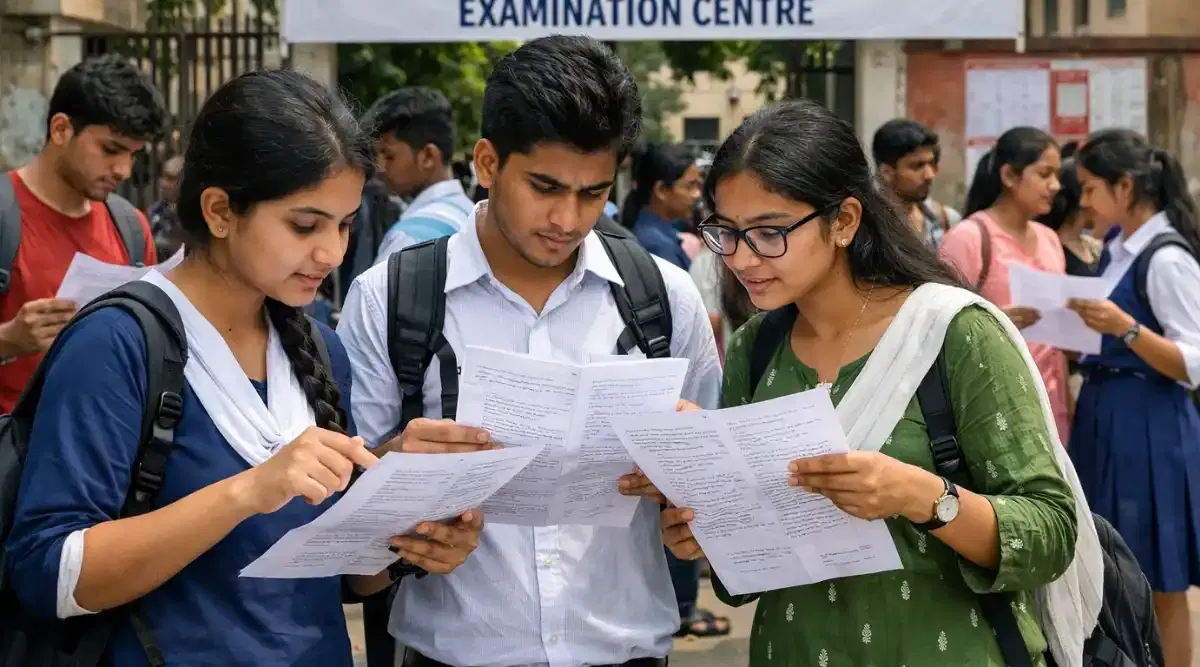
Tamil Nadu 12th Chemistry Exam Pattern 2026 - Check Marking Scheme
Table of Contents
The Tamil Nadu 12th Chemistry exam pattern 2025–2026 covers the following topics: the weighting of the various syllabus topics; the types of questions that will be asked in the board exam; the marks assigned to each question and section of the exam; the criteria by which each section of the exam is evaluated; and the rules governing the use of negative marking in the exam. You can know which chapter or unit requires the most attention and the types of questions that will be asked in the Tamil Nadu Class 12th Exam 2026 by looking at the exam pattern provided on this page. The exam pattern was created by the Tamil Nadu board to assist students in assessing their aptitude and knowledge.
Studying the Tamil Nadu Class 12th exam pattern 2026 is recommended to get ready for the 2026 board exams. Gaining an understanding of the format of the Tamil Nadu 12th Chemistry exam for 2025–2026 will help you focus and study more effectively. The Tamil Nadu 12th Chemistry exam consists of both objective and descriptive questions. Additionally, answering a question incorrectly does not result in negative marking. As a result, the exam pattern will enable you to achieve a higher score on the board exam.
You can find the Tamil Nadu 12th Chemistry exam pattern on the official Tamil Nadu board website, tamilnadustateboard.org.in. The following is the Tamil Nadu 12th Chemistry exam pattern for those getting ready for the 12th board exam in 2026.
Also read: Tamil Nadu 12th Chemistry syllabus 2026
Tamil Nadu 12th Chemistry exam pattern 2026 - Section Wise
A 70-mark theory section, a 20-mark practical section, and a 10-mark internal assessment section make up the Tamil Nadu 12th Chemistry exam. There are four sections in the chemistry theory paper. There are 15 multiple-choice (MCQ) questions in Part I. Each of these questions is worth one mark out of a possible 15. You will receive a total of 12 marks if you correctly answer 6 of the 9 very short answer questions in Part II, each of which is worth two marks. 6 of the 9 short answer questions in Part III are worth three marks of the 18 possible points. You will receive a total of 25 marks for responding to the five long answer questions in Part IV, with five points awarded for each question. The exam takes three hours to complete. The Tamil Nadu 12th Chemistry Exam Pattern 2026 is detailed in the table below:
| Part | Number of questions | Marks Allotted |
|---|---|---|
| I | 15 | 1 mark for each question |
| II | 6 out of 9 | 2 marks for each question |
| III | 6 out of 9 | 3 marks for each question |
| IV | 5 | 5 marks for each question |
Also read: Tamil Nadu 12th Admit Card 2026
Tamil Nadu 12th Chemistry Marking Scheme 2026
Examining the marking scheme for the various Chemistry syllabus chapters can help you understand how you should prepare for each one of the chapters. The Tamil Nadu 12th Chemistry Marking Scheme 2026 is given in the following table:
| Sections | Type of Questions | Number of Questions | Marks Allotted |
|---|---|---|---|
| Atomic Structure | Objective, very short and short questions | 4 | 7 |
| Periodic Classification | Objective, very short and long questions | 3 | 8 |
| p-Block Elements | Objective, very short and long questions | 4 | 10 |
| d-Block Elements | Objective, very short, short and long questions | 6 | 14 |
| f-Block Elements | Objective and short questions | 3 | 4 |
| Coordination and Bio-coordination Compounds | Objective, short and long questions | 3 | 9 |
| Nuclear Chemistry | Objective, very short and long questions | 3 | 8 |
| Solid State | Objective, very short and long questions | 3 | 8 |
| Thermodynamics - II | Objective, very short and short questions | 4 | 7 |
| Chemical Equilibrium - II | Objective, very short and short questions | 4 | 7 |
| Chemical Kinetics - II | Objective, very short and short questions | 4 | 9 |
| Surface Chemistry | Objective, very short and long questions | 5 | 10 |
| Electrochemistry - I | Objective, very short and long questions | 4 | 13 |
| Electrochemistry - Ii | Long questions | 2 | 10 |
| Isomerism in Organic Chemistry | Very short and long questions | 2 | 7 |
| Hydroxy Derivatives | Objective, very short and long questions | 4 | 10 |
| Ethers | Objective and short questions | 3 | 5 |
| Carbonyl Compounds | Objective, very short, short and long questions | 4 | 11 |
| Carboxylic Acids | Objective, very short, short and long questions | 4 | 11 |
| Organic Nitrogen Compounds | Objective, very short and long questions | 5 | 10 |
| Bio-molecules | Objective and long questions | 3 | 7 |
| Chemistry in Action | Very short and long questions | 2 | 7 |
| Total | 79 (47 optional) | 192 (122 optional) |
Also read: Tamil Nadu 12th Sample Papers 2026
Tamil Nadu 12th Chemistry Unit Wise Marking Scheme 2026
In Tamil Nadu 12th chemistry syllabus, each unit is assigned a different weight. Examining the unit-wise marking scheme for Tamil Nadu 12th chemistry syllabus is important for scoring good marks in board exams. The Tamil Nadu 12th Chemistry unit-wise marking scheme for 2026 is shown in the following table:
| Units | Weightage % | Marks Allotted |
|---|---|---|
| Inorganic Chemistry | 54% | 104 |
| Organic Chemistry | 46% | 68 |
Also read: Tamil Nadu 12th Chemistry Deleted syllabus 2026
How to use Tamil Nadu 12th Chemistry exam pattern 2026?
To plan your studies and prepare for the board examinations, you must know the Tamil Nadu 12th Chemistry exam pattern for 2026. You can prepare for the Tamil Nadu 12th Chemistry exam in 2026 by using the following techniques:
- Make sure your responses are pertinent to the questions by looking at the types of questions asked in each chapter.
- Units with larger weight distributions should be given more time to receive higher grades.
- Make an effort to complete your answers in the allotted three exam hours.
- Complete the sample papers and question papers from the prior year to gain an understanding of the exam format.
- Create a productive schedule according to the exam format so that you can study the material efficiently.
By regularly checking this page before the 12th board examinations, you can get all the information you want regarding the Tamil Nadu 12th Chemistry Exam Pattern for 2025–2026.
FAQs on Tamil Nadu 12th Tamil Nadu 12th Chemistry Exam Pattern
Q: What are the maximum marks for the Tamil Nadu 12th Chemistry theory exam?
Q: What is the maximum time allotted to the Tamil Nadu 12th Chemistry exam?
Q: How many sections are there in the Tamil Nadu 12th Chemistry question paper?
Q: Which unit in Tamil Nadu 12th Chemistry has the maximum marks?
Q: How many questions are there in the Tamil Nadu 12th Chemistry question paper?
Explore Top Colleges In Tamil Nadu VIEW ALL



![Bharathidasan Institute of Technology, [BIT] Anna University, Tiruchirappalli](https://media.getmyuni.com/azure/college-image/small/bharathidasan-institute-of-technology-bit-anna-university-tiruchirappalli.jpg)





Entrance Exams after 12th Boards