Karnataka 2nd PUC Chemistry Latest Syllabus 2025-26: Download Latest and Revised Karnataka 2nd PUC Chemistry Syllabus PDF
The Karnataka 2nd PUC Chemistry Syllabus 2025-26 outlines essential chapters and assessment criteria. It's vital for exam preparation, helping students understand learning outcomes and track progress. Refer to the official syllabus, including reduced topics, for effective study. This guides your Karnataka 2nd PUC 2026 exam readiness.
Table of Contents
- Karnataka 2nd PUC Chemistry Syllabus 2025-26
- Chapter-Wise Topics Under Karnataka 2nd PUC Chemistry syllabus 2025-26
- Karnataka 2nd PUC Reduced Chemistry Syllabus 2025-26
- Steps to download Karnataka 2nd PUC Chemistry Syllabus 2025-26
- How to Prepare with the Karnataka 2nd PUC Chemistry Syllabus 2025-26?
The Karnataka 2nd PUC Chemistry exam syllabus 2025-26 outlines all the important information a student requires to know regarding the chapters to be covered in the course of study. The syllabus is an integral part of the Karnataka 2nd PUC academic module as it provides in-depth insight into the learning outcomes and assessment criteria.
The Karnataka 2nd PUC Chemistry 2025-26 syllabus is available for students, which they should refer to while preparing for the Karnataka 2nd PUC exam 2026. Students can evaluate their learning progress and check their familiarity with the overall structure of the curriculum by reviewing the syllabus extensively.
Karnataka 2nd PUC Chemistry Syllabus 2025-26
Students must prepare for the Karnataka 2nd PUC Chemistry exam 2025-26 by referring to the syllabus provided by the board. The Karnataka 2nd PUC Chemistry syllabus 2025-26 comprises question types, important topics covered, essential notes, unsolved exercises, and more.
The question paper will be curated based on the Karnataka Chemistry 2nd PUC chapters under the provisional syllabus. Further, the board has also provided Karnataka 2nd PUC books that were designed with the latest PUC 2 Chemistry syllabus.
Chapter-Wise Topics Under Karnataka 2nd PUC Chemistry syllabus 2025-26
The Karnataka 2nd PUC chemistry syllabus 2026 is a great learning tool for students as it provides chapter-wise topics along with the marking distribution of each chapter. With the help of the syllabus, students can identify all the important topics and chapters which has a high probability of being presented in the upcoming board exam.
The table below shows the Karnataka 2nd PUC Chemistry chapters list 2026 and unit-wise topics.
| Unit | Chapters |
| The Solid State | Classification of Solids |
| Solutions | Types of Solutions |
| Solubility | |
| Expressing Concentration of Solutions | |
| Ideal and Non-ideal Solutions | |
| Vapor Pressure of Liquid Solutions | |
| Colligative Properties and Determination of Molar Mass | |
| Electrochemistry | Electrochemical Cells |
| Conductance of Electrolytic Solutions | |
| Nernst Equation | |
| Electrolytic cells and Electrolysis(excluding the elementary idea of laws of electrolysis) | |
| Chemical Kinetics | Factors Influencing the Rate of a Reaction |
| Integrated Rate Equations | |
| Rate of a Chemical Reaction | |
| Surface Chemistry | Colloids |
| Adsorption | |
| Classification of Colloids | |
| Colloids Around Us | |
| General Principles and Processes of Isolation of Elements | Occurrence of Metals |
| Concentration of Ores | |
| Extraction of Crude Metal from Concentrated Ore | |
| Thermodynamic and Electrochemical Principles of Metallurgy | |
| Oxidation, Reduction | |
| Refining | |
| p-block elements | Group 15, 16, 17 and 18 Elements |
| Position in the Periodic Table | |
| General Properties | |
| Electronic configuration, oxidation states | |
| d and f Block Elements | Position in the Periodic Table |
| General Properties of the Transition Elements (d-Block) | |
| Electronic Configurations of the d-Block Elements | |
| The Lanthanoids | |
| The Actinoids | |
| Some Applications of d- and f-Block Elements | |
| Coordination Compounds | Definitions of Some Important Terms |
| Werner's Theory of Coordination Compounds | |
| Nomenclature of Coordination Compounds | |
| Bonding in Metal Carbonyls | |
| Bonding in Coordination Compounds | |
| Stability of coordination compounds | |
| Haloalkanes and Haloarenes | Nomenclature |
| Classification | |
| Nature of C–X Bond | |
| Physical Properties | |
| Chemical Reactions | |
| Methods of Preparation | |
| Alcohols, Phenols and Ethers | Nomenclature |
| Classification | |
| Alcohols and Phenols | |
| Structures of Functional Groups | |
| Ethers | |
| Aldehydes, Ketones and Carboxylic Acids | Nomenclature |
| Nature of carbonyl group | |
| Methods of preparation | |
| Physical and chemical properties | |
| Amines | Nature of carbonyl group |
| Nomenclature | |
| Methods of preparation | |
| Physical and chemical properties | |
| Biomolecules | Carbohydrates |
| Proteins | |
| Vitamins | |
| Polymers | Classification of Polymers |
| Chemistry in Everyday Life | - |
Karnataka 2nd PUC Reduced Chemistry Syllabus 2025-26
The Karnataka Board has deleted some of the topics from the Karnataka 2nd PUC chemistry syllabus, such as the solid state, surface chemistry, and other chapters. Students can prepare for the exams as per the revised curriculum, and the 2nd PUC Chemistry mid term syllabus 2025-26 is based on it.
The syllabus for Karnataka 2nd PUC Chemistry 2025-26 is available in the table, which can be downloaded in PDF format.
| Particulars | PDF Link |
| 2nd PUC Chemistry Syllabus Karnataka PDF 2025-26 | Download Now |
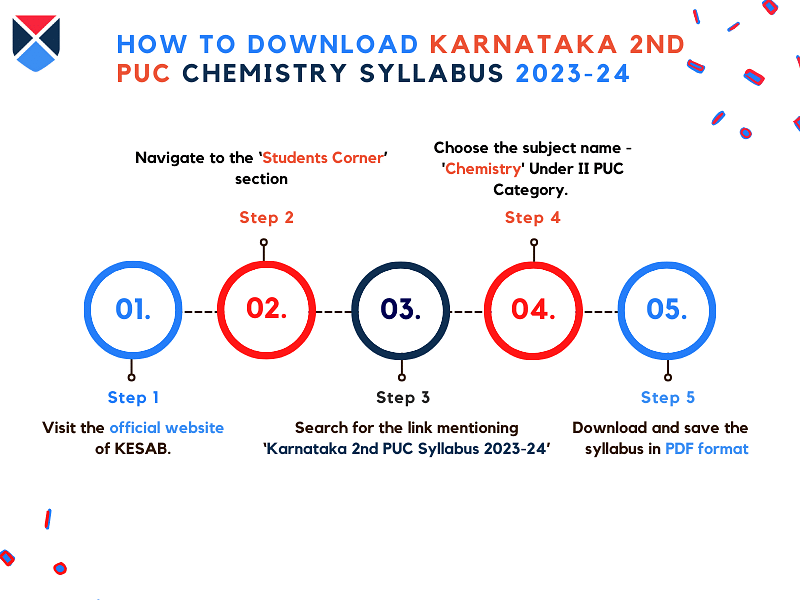
Steps to download Karnataka 2nd PUC Chemistry Syllabus 2025-26
The Karnataka 2nd PUC syllabus 2026 is available for all subjects including Chemistry and students should review the syllabus accordingly for effective preparation. The instructions below show the downloading process of the Karnataka 2nd PUC Chemistry syllabus 2025-26.
- Step 1: Students need to visit the official website of KSEAB - kseab.karnataka.gov.in
- Step 2: Navigate to the ‘Students Corner’ section and select the link mentioning “Karnataka 2nd PUC 2025-26 Reduced Syllabus”.
- Step 3: Choose the 2nd PUC Category and click the link mentioning ‘II PUC Reduced syllabus (NCERT Adopted Subjects ).
- Step 4: Now choose the subject name and select the submit button to view the syllabus in PDF format.
- Step 5: Download the syllabus and save it for future reference.
How to Prepare with the Karnataka 2nd PUC Chemistry Syllabus 2025-26?
The Karnataka 2nd PUC Chemistry syllabus 2025-26 provides a comprehensive idea of the basic element of the curriculum which can assist students in their preparation. The important tips below can help students prepare for the upcoming board exam with the help of the syllabus.
- Choose the important topics with the highest marks and practice accordingly.
- Create a timeline for the completion of the whole syllabus.
- Categorize the syllabus in different segments to cover every topic.
- Candidates should cover all the topics in the syllabus.
- Review the whole syllabus before the exam.
FAQs on Karnataka 2nd PUC Chemistry
Q: What is the Karnataka 2nd PUC Chemistry syllabus 2025-26?
Q: Has the Karnataka 2nd PUC Chemistry syllabus been revised for 2025-26?
Q: Where can I download the Karnataka 2nd PUC Chemistry Syllabus 2025-26 PDF?
Q: How can the syllabus help in exam preparation for 2025-26?
Q: Are there specific books recommended for the 2nd PUC Chemistry syllabus?
Explore Top Colleges In Karnataka VIEW ALL






![Shri Basaveshwara Vidya Vardhak Sangha Ayurvedic Medical College, [SBVVSAMC] Bagalkot](https://media.getmyuni.com/azure/college-image/small/shri-basaveshwara-vidya-vardhak-sangha-ayurvedic-medical-college-sbvvsamc-bagalkot.jpg)

![Shri Vijay Mahantesh Vidya Vardhak Sangha Ayurvedic Medical College, [SVMVVSAMC] Bagalkot](https://media.getmyuni.com/azure/college-image/small/shri-vijay-mahantesh-vidya-vardhak-sangha-ayurvedic-medical-college-svmvvsamc-bagalkot.jpg)

Entrance Exams after 12th Boards