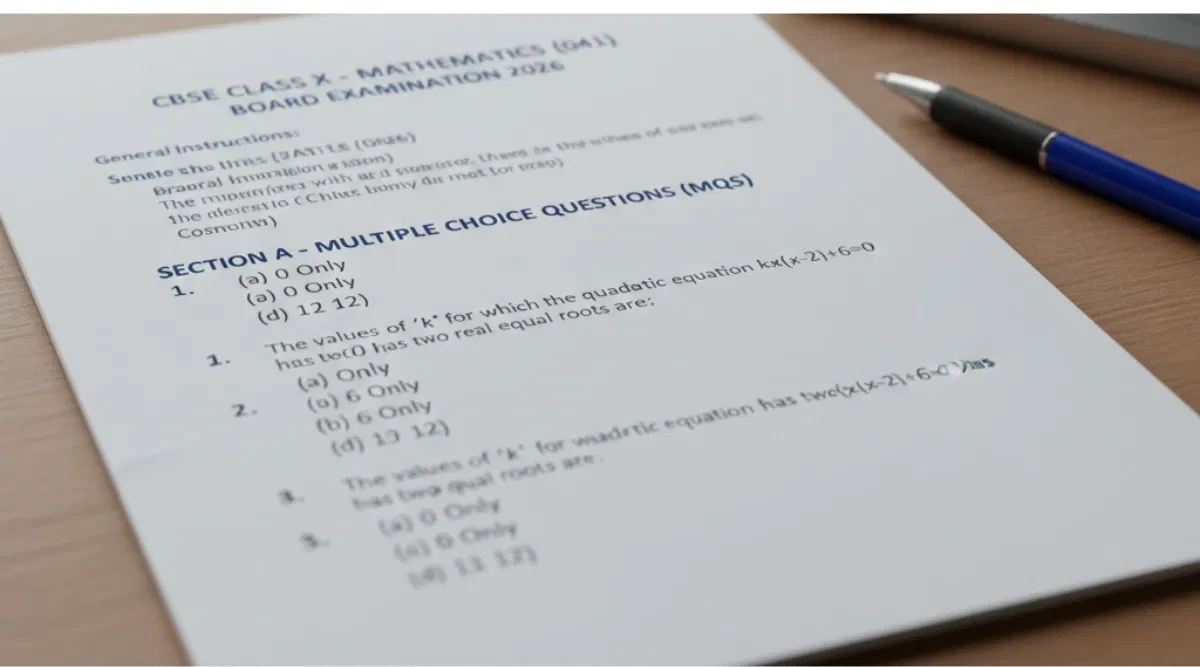
CBSE 10th Mathematics Exam Pattern 2026 – Check Marking Scheme
Table of Contents
The CBSE 10th Mathematics Exam Pattern has been designed in such a way that it tests the conceptual understanding and problem-solving ability of students. The exam pattern aligns with the NEP (National Education Policy). Also, the marking and weightage schemes are rational, and more importance has been given to the fundamental topics. If you are preparing for the CBSE 10th Exam 2026, then make sure to follow the latest exam pattern. It will help you achieve outstanding results.
The CBSE 10th Exam Pattern 2026 aims at improving competency-based learning. Once you understand the latest CBSE 10th Mathematics Exam Pattern, you’ll score excellent marks for sure. The Mathematics exam will be divided into theory and internal assessment. The theory paper will be for 80 marks, and 20 marks are allotted for the internal assessment. In the theory question paper, you will find MCQs, case-based, long, and short-type questions. The good thing is that there is no negative marking. Hence, you should always try to attempt all the questions without the fear of losing any marks for incorrect answers.
Understanding the exam pattern will help you in better time management, and you can also prioritize the chapter-wise study. This article covers every single aspect of the CBSE 10th Mathematics Exam Pattern. Hence, you should carefully go through the upcoming details.
Also Read: CBSE Class 12 Mathematics Syllabus 2026
CBSE 10th Mathematics Exam Pattern 2026 – Section Wise Analysis
To understand the CBSE 10th Mathematics Exam Pattern 2026, you must know how the question paper is set. The CBSE 10th class Mathematics theory question paper will carry 80 marks, and 20 marks will be allotted for the internal assessment. The 20 marks internal assessment will comprise a pen paper test of 5 marks, multiple assessment of 5 marks, lab practical of 5 marks, and portfolio of 5 marks. For the main theory exam, you will get 3 hours to solve the paper. There will be twenty MCQs of 1 mark each in section A. Five very short questions of 2 marks each in section B. Six short questions of 3 marks each in section C. Four long questions of 5 marks each in section D. Three case-based questions of 4 marks each in section E. The table below will help you to understand the exact CBSE 10th Mathematics theory question paper pattern.
|
Section |
Type of Questions |
Number of Questions |
Marks Allotted |
|
A |
MCQS and assertion-reason based |
20 |
20 x 1 = 20 |
|
B |
Very short |
5 |
5 x 2 = 10 |
|
C |
Short |
6 |
6 x 3 = 18 |
|
D |
Long |
4 |
4 x 5 = 20 |
|
E |
Case-based |
3 |
3 x 4 = 12 |
|
Total |
|
38 |
80 marks |
Also Read: CBSE 10th Class Admit Card 2026
CBSE 10th Mathematics Marking Scheme 2026
You must know the chapter-wise marking scheme for the CBSE 10th Mathematics. It will help you to draft a correct timetable while studying. The table below discusses the CBSE 10th Mathematics Marking Scheme 2026 in a simplified way.
|
Sections (Chapter Wise) |
Type of Questions |
Number of Questions (Approximately) |
Total Marks Allotted |
|
Number Systems Chapter 1st – Real Numbers (6 marks) |
MCQs, short |
4 |
6 |
|
Algebra Chapter 2nd – Polynomials (4 marks) Chapter 3rd – Pair of Linear Equations in Two Variables (6 marks) Chapter 4th – Quadratic Equations (6 marks) Chapter 5th – Arithmetic Progressions (4 marks) |
Long, short, and MCQs |
8 |
20 |
|
Coordinate Geometry Chapter 7th – Coordinate Geometry (6 marks) |
Short |
3 |
6 |
|
Geometry Chapter 6th – Triangles (8 marks) Chapter 10th – Circles (7 marks) |
Long and short |
5 |
15 |
|
Trigonometry Chapter 8th – Introduction to Trigonometry (8 marks) Chapter 9th – Some Applications of Trigonometry (4 marks) |
MCQs, long, and short |
7 |
12 |
|
Mensuration Chapter 11th – Area Related to Circles (3 marks) Chapter 12th – Surface Areas and Volumes (7 marks) |
Short and long |
5 |
10 |
|
Statistics and Probability Chapter 13th – Statistics (7 marks) Chapter 14th – Probability (4 marks) |
Short and long |
6 |
11 |
|
Total |
|
38 |
80 marks |
Also Read: CBSE 10th Sample Papers
CBSE 10th Mathematics Unit Wise Marking Scheme 2026
The table below shares the unit-wise weightage and allotment of marks in CBSE 10th Mathematics theory portion. Have a look at the classification.
|
Topics/ Units |
Weightage % |
Marks Allotted |
|
Number Systems |
7.5% |
6 |
|
Algebra |
25% |
20 |
|
Coordinate Geometry |
7.5% |
6 |
|
Geometry |
18.75% |
15 |
|
Trigonometry |
15% |
12 |
|
Mensuration |
12.5% |
10 |
|
Statistics and Probability |
13.75% |
11 |
|
Total |
100% |
80 marks |
You must note that the weightage-based percentages mentioned above are the approximate values based on the latest CBSE 10th Mathematics syllabus and exam pattern. If you want to know the most accurate and up-to-date weightage pattern, syllabus, or exam pattern, you should visit the official website of the board at cbseacademic.nic.in.
Also Read: CBSE 10th Mathematics Deleted Syllabus 2026
How to Use the CBSE 10th Mathematics Exam Pattern 2026?
You can use the CBSE 10th Mathematics Exam Pattern to achieve excellent results, and here is how it will help you –
-
By understanding the CBSE 10th Mathematics Exam Pattern, you can focus on the high-weightage units first. It will improve your scores for sure.
-
You will understand which sections are the most crucial ones from the main paper point of view, and it will simulate exact exam-like conditions.
-
You can allocate the right amount of time to each unit, and it will lead to better time management. Your speed and accuracy will improve.
-
When you solve the mock tests and previous years’ Mathematics question papers, the knowledge of the exam pattern will help you a lot.
-
Because of the CBSE 10th Mathematics Exam Pattern, you can understand your strengths and weaknesses. Let’s say, you are good with the short-type questions. Then, while attempting the paper, try to solve MCQs and short-type questions first.
-
Knowing the exam pattern gives confidence, and it will help in better practice and revision.
Also Read: CBSE 10th Class Preparation Tips 2026
For more useful updates related to the CBSE 10th Exam, follow Getmyuni!
FAQs on CBSE 10th CBSE 10th Mathematics Exam Pattern
Q: From where can I download the CBSE 10th Mathematics deleted syllabus 2026?
Q: Why was the CBSE 10th Mathematics syllabus 2026 deleted?
Q: Is the CBSE 10th Mathematics syllabus 2026 easy now after the deletion?
Q: How can I prepare with the CBSE 10th Mathematics syllabus 2026?
Q: Are the topics from all the chapters deleted in the CBSE 10th Mathematics syllabus 2026?
Q: How to use the CBSE 10th Mathematics Exam Pattern for better preparation?
Q: How to solve the confusion regarding the CBSE 10th Mathematics Exam Pattern?
Q: What is the exact CBSE 10th Mathematics Exam Pattern 2026?
Q: As per the CBSE 10th Exam Pattern, is there any negative marking in the Mathematics paper?
Q: How to download the official CBSE 10th Mathematics Exam Pattern?




![Motilal Nehru National Institute of Technology, [MNNIT] Allahabad](https://media.getmyuni.com/azure/college-image/small/motilal-nehru-national-institute-of-technology-mnnit-allahabad.webp)