ICSE Class 10 Economics Latest Syllabus 2025-26: Download Latest and Revised ICSE Class 10th Economics Syllabus PDF
Table of Contents
The ICSE class 10 Economics syllabus will give a good understanding of the topics, paper pattern, and assessment topics for the upcoming board exam. Students must thoroughly use the updated Economics syllabus as it equips students to make better decisions and understand complex markets.
The ICSE class 10 Economics 2025-26 syllabus consists of 6 chapters: the theory paper contains 80 marks, and the internal assessment includes 20. Moreover, it also helps the students to understand the various aspects of the subject.
ICSE Class 10 Economics Syllabus: PDF Download
The board has released the ICSE class 10 Economics syllabus 2025-26 on the official website. Students can also refer to the link mentioned below to download the updated syllabus in PDF format.
| Particulars | PDF Link |
| ICSE Class 10 Economics Syllabus 2025 | Download PDF |
ICSE Class 10 Economics 2025-26 Syllabus: Chapter-Wise Details
The ICSE class 10 Economics paper will be conducted for 2 hours in pen and paper mode. The class 10 Economics syllabus influences daily life and plays a significant role in the functioning of society. Therefore, students must adequately study this subject to ace the upcoming board exams.
ICSE Class 10 2025-26 Economics Syllabus: Chapter 1 The Productive Mechanism
Refer to the table mentioned below to understand the ICSE Class 10 Economics syllabus for Chapter 1.
| Topics | Sub-Topics |
| Land |
|
| Labour |
|
| Capital |
|
| Entrepreneur |
|
ICSE Class 10 Economics Syllabus: Chapter 2 Theory of Demand and Supply
The chapter 2 ICSE class 10 Economics 2025 syllabus is mentioned below for the students' reference.
| Topics | Sub-Topics |
| Meaning and concept of Demand and Supply |
|
| Elasticity of Demand and Elasticity of Supply |
|
ICSE Class 10 Economics Syllabus 2025-26: Chapter 3 Market
The ICSE Class 10 Economics syllabus for chapter 3 is tabulated below for the students' reference.
| Topics | Sub-Topics |
| Meaning and Types |
|
ICSE Class 10 Economics Syllabus: Chapter 4 Banking in India
Refer to the table mentioned below to understand Chapter 4 of the ICSE Class 10 Economics syllabus.
| Topics | Sub-Topics |
| Money |
|
| Commercial Banks |
|
| Central Bank |
|
| Monetary Policy of the Central Bank |
|
| Demonetisation | A brief understanding |
| Public Finance |
|
ICSE Class 10 2025-26 Economics Syllabus: Chapter 5 Inflation
Tabulated below is the ICSE class 10 Economics syllabus chapter 5 for students' reference.
| Topics | Sub-Topics |
| Inflation, Wholesale Price Index (WPI), Consumer Price Index (CPI), Food Basket | Meanings: Inflation, Wholesale Price Index (WPI), Consumer Price Index (CPI), Food Basket |
| Stages of Inflation | Meanings: Creeping, Walking, Running and Hyper |
| Types of Inflation | Cost-push inflation and demand-pull inflation |
ICSE Class 10 Economics Syllabus 2025-26: Chapter 6 Consumer Awareness
Chapter 6 of the ICSE Class 10 Economics syllabus is given below for the students' reference.
| Topics | Sub-Topics |
| Consumer Exploitation and Consumer Awareness |
|
| Consumer Rights & Duties |
|
| Food Adulteration | Meaning and harmful effects |
| Technical and Administrative measures for Consumer Protection |
|
Read More: ICSE Class 10 Previous Year Question Papers
ICSE Class 10 Economics Syllabus 2025-26: Marking Scheme
Students must also consider the subject-wise marking scheme while preparing for the ICSE class 10 board exams 2025-26. It will help them to focus on the chapter, which carries more weight. Moreover, provided below are the detailed question paper
| Marks | Details | Number of Questions |
| 80 marks | Section 1: Short questions | Multiple |
| Section 2: Long answer questions | 6 Questions | |
| 20 Marks | Practical Assessment |
Read More: ICSE Class 10 Passing Marks
ICSE Class 10 Economics Internal Assessment Syllabus
The board will conduct an Internal assessment for 20 marks in their respective schools. Students must complete one project or assessment as instructed by their teacher. Some of the suggested internal evaluations include:
- A visit to a local industrial unit and analysis of the combination of the factors of production being used in the production process.
- Surveying 15 people from the neighbourhood about the type of taxes they pay. From the survey, students must conclude which type of tax is more accessible to pay and why.
- To visit a nearby store. Select five items of regular consumption. Study the following: the impact of GST on these five products, how this has impacted the demand for these products, and how it has benefited the producer, consumer and the government.
ICSE Class 10 Economics Syllabus: Evaluation Process
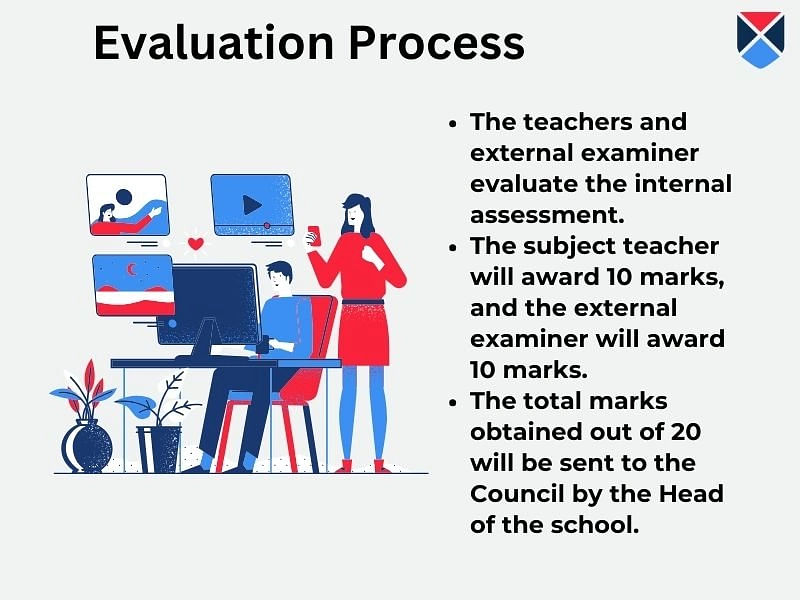
The external examiner evaluates the projects or the assessment. The school authorities appoint these external examiners. Moreover, the Internal Examiner and the External Examiner will assess the assignments independently. Refer to the table mentioned below to understand the evaluation process of the ICSE Class 10 Economics syllabus.
| Evaluation Component | Internal Examiner Marks | External Examiner Marks | Total Marks |
|---|---|---|---|
| Assignments/ Project Work Evaluation | 10 | 10 | 20 |
The image provided below is the detailed evaluation process of the ICSE Class 10 Economics syllabus.




![Motilal Nehru National Institute of Technology, [MNNIT] Allahabad](https://media.getmyuni.com/azure/college-image/small/motilal-nehru-national-institute-of-technology-mnnit-allahabad.webp)