UP Class 10 Social Science Latest Syllabus 2025-26: Download Latest and Revised UP Class 10th Social Science Syllabus PDF
Table of Contents
- UP Board Class 10 Social Science Syllabus 2025-26
- UP Board Class 10 Social Science Syllabus 2025-26: Marking Scheme
- Class 10 Social Science Syllabus 2025-26 UP Board: Question Pattern
- Steps to Download the UP Board Class 10 Social Science Syllabus 2025-26
- Books Based On UP Board Class 10 Social Science Syllabus 2025-26
- UP Board Class 10 Social Science Syllabus 2023-24
The UP Board class 10 Social Science syllabus 2025-26 is divided between History, Geography, Civics, and Economics. Important chapters such as Livelihood, Manufacturing Industry, Economy, Political Parties, Agriculture, Daily Life, Culture, Politics, and more are covered in the syllabus.
The class 10 Social Science syllabus 2025-26 UP Board contains a total of 11 chapters. The chapters under India & the Contemporary World - 2 and Contemporary India - 2 carry the highest weightage in the UP Board 10th exam as per the current syllabus.
UP Board Class 10 Social Science Syllabus 2025-26
The UP Board class 10 syllabus for Social Science is as follows.
Unit - India and the Contemporary World – 2 (History)
Part I
The rise of nationalism in Europe
- The rise of nationalism in Europe after 1830
- Thoughts of Joseph Mazzini, etc.
- Characteristics of the movements in Poland, Hungary, Italy, Germany, and Greece
Nationalism in India
- Effects of World War I, Khilafat Movement, Non-cooperation, and ideologies among various movements.
- Salt March (Dandi March)
- Movements of tribals, workers, and peasants
- Limitations of the Civil Disobedience Movement
- sense of collective belonging
Part II
Careers, Economy, and Society
- The making of a modern world
- Pre-modern world
- 19th century (1815 – 1914) world economy (colonialism)
- Economic recession between the world wars (Great Depression)
- Restructuring of the world economy (the beginning of globalization)
The era of industrialization
- Before the Industrial Revolution and the pace of industrial change
- working life
- Industrialization in the colonies
- Primary entrepreneurs and activists
- The irresistibility of industrial development
- Market for products
Part III
Daily life, culture, and politics
- Print culture and the modern world
- History of printing in Europe
- Development of the Press in India in the 19th Century
- Relations between politics, public controversy, and print culture
Map Work - History: Political Map of India
Chapter – 3: Nationalism in India (1918 – 1930)
Display and naming
- Sessions of the Indian National Congress
- Calcutta (September 1920)
- Nagpur (December 1920)
- Madras (1927)
- Lahore (1929)
- Important centres of the Indian National Movement (Non-cooperation Movement and Civil Disobedience Movement)
- Champaran, Bihar - Indigo Farmers' Movement
- Kheda (Gujarat)- Farmer Satyagraha, Ahmedabad (Gujarat) – Cotton Mill Workers Satyagraha, Amritsar (Punjab) - Jallianwala Bagh massacre, Chora-Chori (Uttar Pradesh): Non-cooperation movement announced. Dandi (Gujarat): Civil Disobedience Movement
Unit 2 - Contemporary India – 2 (Geography)
Part I
- Resources and Development – Types – Natural and Artificial Resources, Need for Resource Planning, Natural Resources, Land as a Resource, Soil Types and their Distribution, Change in Land Use Pattern, Methods of Preventing Soil Erosion
Forest and Wildlife Resources – Flora and Fauna in India, Conservation of Forest and Wildlife in India. - Water Resources – Resources, Distribution, Uses, Multipurpose Projects, Water Scarcity, Need for Management and Conservation, Rainwater Harvesting.
- Agriculture – Types of agriculture, main crops, cropping patterns, technological and institutional improvements, contribution of agriculture to the economy, and employment generation.
- Mineral and Energy Resources: Types of minerals, distribution (for map only), uses and economic importance of minerals, conservation, types of energy resources, conventional and non-conventional energy resources, distribution, use and conservation.
Part II
- Manufacturing industries: types, spatial distribution (for maps only), contribution of industries to the national economy, industrial pollution, and environmental degradation.
- Life of the national economy: Importance of communication and transport, trade, and tourism.
Map Work- Geography: Political Map of India
Chapter 1: Resources and Development (Identifying the Major Types of Currencies)
Chapter 3: Water Resources (Showing and Naming)
- Dams
- Salute Bhakra
- Nangal Dam
- Tehri Rana Pratap Sagar
- Sardar Sarovar
- Hirakud Nagargun Sagar Tungabhadra (including rivers)
Chapter – 4: Agriculture
- Only identification
- Main rice and wheat growing areas
- Main and largest producing states: Sugarcane, tea, coffee, rubber, cotton, and jute.
Unit 3 - Democratic Politics (Civics)
Part I
Chapters I and II
Power-sharing and federalism: Why and how is power-sharing essential in democratic nations? How does federal power sharing contribute to national unity? To what extent does decentralization achieve this goal? How does democracy integrate different social groups?
Chapters III and IV
- Democracy and diversity
- Caste, religion and gender issues
- Is division inherent in a democratic system? What impact does caste have on politics, and politics on caste? How has gender discrimination affected politics? How do communal differences affect democracy?
Part II
Chapter 5
- Popular struggles and movements
- Political parties - what is the role of political parties in competition and opposition? What are the major national and state political parties in India?
- The consequences of democracy
- Can or should democracy be judged by its results?
- What can one expect from democracy? Does Indian democracy meet these expectations?
- Is democracy leading people towards development, security, and respect?
- Who keeps democracy alive in India?
- Challenges to democracy
- Is the ideology of democracy weakening?
- What are the major challenges facing Indian democracy?
- How can democracy be improved and strengthened?
- What can an ordinary citizen do to strengthen democracy?
Unit 4 - Understanding Economic Growth (Economics)
Part I
- Development: Traditional concept of development, National Income and Per Capita Income, Income and other targets, Average Income, Income and various parameters, Infant Mortality Rate, Growth Rate.
- Sectors of the Indian Economy: Sectors of economic activity, historical changes in the sector, growing importance of the tertiary sector, employment generation, division of work sectors – organised and unorganised, measures to protect workers in the unorganised sector
- Money and Credit: Role of money in the economy, Formal and informal financial institutions for savings and loans – General introduction, A formal institution like nationalized commercial banks and some informal financial institutions should be selected, local money lenders, landlords, chit funds, and private finance companies
Part II
- Globalization and the Indian Economy: Production in different countries, foreign trade, and linking of different markets. What is globalization? Factors, World Trade Organization (WTO), effects, and rationale for globalization.
- Consumer Rights: How are consumers exploited? (Including one or two case studies), Causes of consumer exploitation, increasing consumer awareness, and what should a consumer be like in the marketplace? Role of the government in consumer protection.
UP Board Class 10 Social Science Syllabus 2025-26: Marking Scheme
70 marks are allotted for the UP Board class 10 theory exam, and the rest of 30 marks are assigned for the practical work. The questions under the History and Geography subject contain 20 marks each. The rest of the 30 marks are equally allocated between Civics and Economics.
Students should check the UP Board class 10 exam pattern in detail for the chapter-wise marking scheme. Check the table below and know the marking allocation for each chapter under the UP Board class 10 Social Science syllabus 2025-26.
| Exam | Unit Name | Marks |
| Theory Exam | India and the Contemporary World - 2 (History) | 20 |
| Contemporary India - 2 (Geography) | 20 | |
| Democratic Politics - 2 (Civics) | 15 | |
| Understanding of Economic Development (Economics) | 15 | |
| Internal Assessment | First Internal Assessment Examination – (Experimental and Project Work) in August | 10 |
| Second Internal Assessment Examination – (Experimental and Project Work) in December | 10 | |
| Monthly Exams in May, July, November, and December | 10 |
Class 10 Social Science Syllabus 2025-26 UP Board: Question Pattern
The UP Board class 10 Social Science exam contains objective-type questions, short-type questions, and questions based on map work, divided into three sections. The question paper includes different question patterns with total marks ranging between 10 and 20. Check the question pattern according to the Social Science class 10 UP Board Syllabus 2025-26, provided in the table below.
| Sections | Questions Types | Marks |
| Section A | Objective Questions | 20 |
| Section B | Very Short Type Questions | 16 |
| Short Type Questions | 24 | |
| Section C | Map-Based Questions | 10 |
Steps to Download the UP Board Class 10 Social Science Syllabus 2025-26
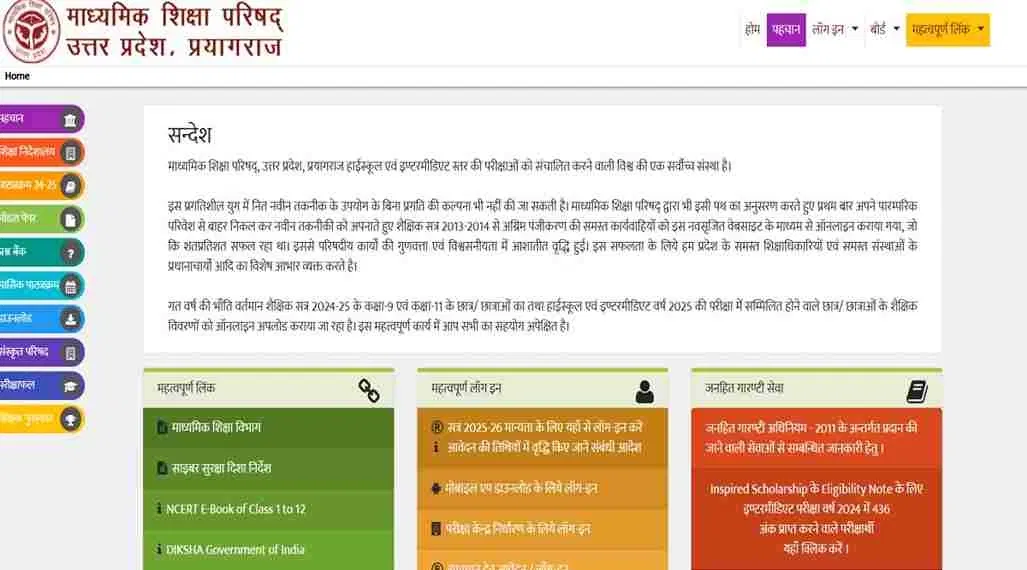
The UP class 10 syllabus 20246 for all subjects is uploaded on the official website of UPMSP. The following are the instructions that students can follow to download the class 10 UP Board Social Science syllabus.
- Step 1: Visit the official website of UPMSP and head to the menu bar, located on the left side of the home page.
- Step 2: Click the link mentioning ‘Course 2025-26’ and navigate to the ‘Syllabus Class 10th’ table.
- Step 3: Click on the link for the subject name - ‘Social Science’.
- Step 4: The syllabus will open on a new tab.
- Step 5: Students can download the syllabus of Social Science class 10 UP board in PDF format for future reference.

Books Based On UP Board Class 10 Social Science Syllabus 2025-26
Most of the UP class 10 Social Science books are available online, which students can study while preparing for the exam. The list of books available that are curated based on the class 10 UP Board Social Science syllabus is shown in the table below.
| Name of the Books | Name of the Author or Publisher |
| Contemporary India | NCERT Publication |
| India and the Contemporary World II | NCERT Publication |
| Understanding Economic Development | NCERT Publication |
| Democratic Politics | NCERT Publication |
UP Board Class 10 Social Science Syllabus 2023-24
The UPMSP board published the class 10 Social Science syllabus UP Board 2023-24 for students to review the chapter-wise topics under the theory exam. The syllabus also includes detailed coursework for the monthly exam and project work under the internal evaluation.
Students can refer to the table below to download the Social Science class 10 syllabus UP Board and prepare for the board exam accordingly.
| Particulars | PDF Link |
| Class 10 Social Science syllabus 2023-24 UP Board | Download Now |