
Table of Contents
- COMEDK UGET 2025 Physics Overview
- Detailed COMEDK UGET 2025 Physics Syllabus
- Topic-wise Weightage in COMEDK UGET Physics (Expected)
- COMEDK UGET 2025 Physics Syllabus (Unit-wise Reference)
- Best Books for COMEDK Physics Preparation
- COMEDK UGET 2025 Physics Section Exam Pattern
- Preparation Tips for COMEDK 2025 Physics
- How to Tackle Tricky Physics Questions in COMEDK?
For students who wish to pursue engineering courses in Karnataka, it is important to know that the COMEDK UGET Physics syllabus is a critical part of the examination. Physics is an important subject that is considered for your cumulative score and can very well decide your ultimate rank.
The goal of the COMEDK UGET 2025 Physics curriculum is to assess the students' understanding of foundational ideas and their application in practical situations. The syllabus covers both theoretical and numerical concepts from mechanics, thermodynamics, electromagnetic waves, optics, and current physics, and it is based on the NCERT curriculum for Classes 11 and 12. To do well on the Physics portion of the test, one must have a solid understanding of these ideas. To help you organise your study and concentrate on the most crucial subjects, this page offers a thorough class-by-class description of the COMEDK UGET Physics syllabus.
COMEDK UGET 2025 Physics Overview
Physics involves more than just calculations; it involves getting to the root of everyday phenomena and discovering how things work. In COMEDK UGET, Physics evaluates how well you understand the concepts, the level of intuition you have, and your ability to apply the knowledge to practical situations. Of the 180 questions in the exam, 60 come from Physics, which also balances Mathematics and Chemistry. Command on this subject may improve your score significantly.
Detailed COMEDK UGET 2025 Physics Syllabus
You may notice that the topics listed under the COMEDK Physics Syllabus have been taken from Class 11 and Class 12 NCERT textbooks. You will find them listed in broken-down format below:
|
S. No. |
Unit |
Subtopics |
|
1 |
Heat and Thermodynamics |
Thermal expansion of solids, liquids, and gases |
|
|
|
Specific heat capacities |
|
|
|
Relationship between Cp and Cv for gases |
|
|
|
First law of thermodynamics |
|
|
|
Thermodynamic processes |
|
|
|
Second law of thermodynamics |
|
|
|
Carnot cycle and heat engine efficiency |
|
2 |
Oscillations |
Simple harmonic motion |
|
|
|
Equations of SHM |
|
|
|
Kinetic and potential energies in SHM |
|
|
|
Damped and forced oscillations (basics) |
|
3 |
Thermal and Chemical Effects of Currents |
Heating effects of current |
|
|
|
Electric power and energy |
|
|
|
Thermoelectricity basics |
|
|
|
Seebeck effect and thermocouple |
|
|
|
Faraday's laws of electrolysis |
|
4 |
Motion in One Dimension |
Concepts of displacement, velocity, and acceleration |
|
|
|
Equations of motion |
|
|
|
Graphical representation |
|
|
|
Uniform and non-uniform motion |
|
|
|
Uniformly accelerated motion and applications |
|
5 |
Motion in Two and Three Dimensions |
Scalars and vectors |
|
|
|
Vector addition and resolution |
|
|
|
Scalar and vector products |
|
|
|
Uniform circular motion |
|
|
|
Projectile motion |
|
6 |
Electrostatics |
Electric charge, unit and conservation |
|
|
|
Coulomb’s law |
|
|
|
Dielectric constant |
|
|
|
Electric field and lines of force |
|
|
|
Electric dipole in a uniform electric field |
|
|
|
Electric flux and Gauss’s theorem |
|
|
|
Electric potential and field due to point charge |
|
|
|
Capacitance and capacitors (series and parallel) |
|
|
|
Energy stored in capacitors |
|
7 |
Current Electricity |
Ohm’s Law and resistivity |
|
|
|
Series and parallel circuits |
|
|
|
Kirchoff’s laws |
|
|
|
Wheatstone bridge |
|
|
|
Potentiometer |
Click to read: COMEDK UGET 2025 Syllabus
Topic-wise Weightage in COMEDK UGET Physics (Expected)
Although the COMEDK UGET Physics topic weighting varies significantly from year to year, some chapters, such as Current Electricity, Laws of Motion, and Ray Optics, regularly receive better grades. Prioritising relevant topics and better managing study time are made possible by knowing the predicted weighting.
|
Physics Topics |
Expected No. of Questions |
|
Heat and Thermodynamics |
7–8 |
|
Oscillations and Waves |
5–6 |
|
Electrostatics and Capacitors |
8–10 |
|
Current Electricity |
6–7 |
|
Motion in One and Two Dimensions |
8–9 |
|
Vectors and Scalars |
4–5 |
|
Thermal and Chemical Effects of Currents |
4–5 |
|
Others (Gravitation, Work-Energy, etc.) |
5–6 |
COMEDK UGET 2025 Physics Syllabus (Unit-wise Reference)
Students can see the table below to understand the chapters included in the syllabus:
|
Unit Name |
Chapters Included |
|
Heat and Thermodynamics |
Thermal expansion, Cp and Cv, laws of thermodynamics, Carnot cycle |
|
Oscillations |
SHM, energy in SHM |
|
Thermal and Chemical Effects of Current |
Heating effect, Seebeck effect, Faraday’s law |
|
Motion in One and Two Dimensions |
Kinematics, vectors, projectile and circular motion |
|
Electrostatics |
Electric charge, field, potential, Gauss’ law, capacitance |
Best Books for COMEDK Physics Preparation
For the best results while preparing for the COMEDK UGET Physics, it is important to use the right books. Therefore, the best options are provided below:
|
Book Title |
Author/Publisher |
|
Concepts of Physics (Vol I & II) |
H.C. Verma |
|
Physics for Karnataka CET & COMEDK |
BASE Institute |
|
Aptitude Problems in Physics |
S.S. Krotov |
|
Physics for Karnataka CET & COMEDK |
S. Dasharathi |
|
NCERT Physics (Class 11 & 12) |
NCERT |
COMEDK UGET 2025 Physics Section Exam Pattern
Candidates can check the exam pattern details related to the Physics subject below:
|
Particulars |
Details |
|
Mode of Exam |
Computer-Based Test (CBT) |
|
Duration |
3 Hours |
|
Total Physics Questions |
60 |
|
Type of Questions |
Multiple Choice (MCQs) |
|
Marking Scheme |
+1 for correct, no negative |
Preparation Tips for COMEDK 2025 Physics
When approached with the right strategy, preparing for Physics in COMEDK UGET 2025 can be less overwhelming. These strategies will enhance your confidence, whether you're in an active prep or revision session.
1) Understand concepts, don’t memorise
Understanding Physics requires far more than clicking the memorisation button. The nature of math/physics questions asks for the application of learned concepts rather than simplistic regurgitation of terms. That can happen only if you go deeper than reading the lines and appreciate the cause-and-effect relationships that exist. Start learning using good concept-based visual and real-life videos to build a strong foundation for all concepts.
2) Practice regularly
Being consistent is critical. Committing to practice a variety of questions, especially MCQs, helps in getting used to the exam format. Begin solving questions from a particular topic and progressively advance to mixed question sets to emulate exam conditions. This prepares you for the actual exam, where you will need to answer 60 Physics questions in a single sitting.
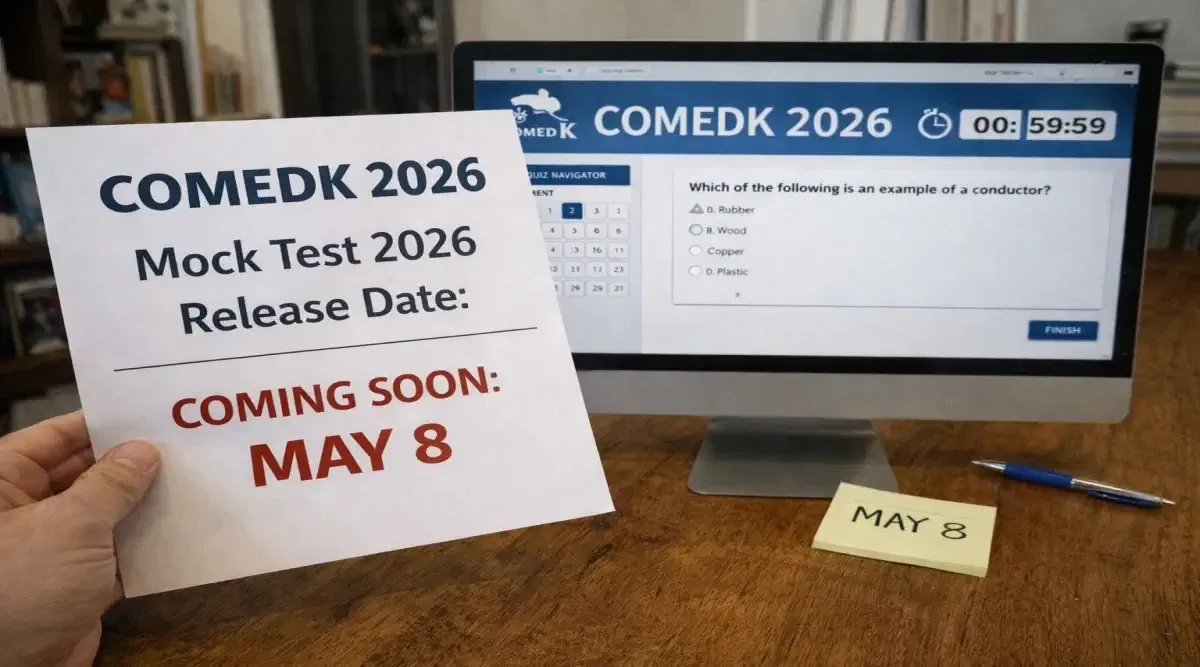
3) Use mock tests
Additionally, mock tests are useful for pacing, besides assessing your knowledge. Incorporate COMEDK full-length mock tests into your weekly routine—aim for once a week. Ensure you time yourself, evaluate where you went wrong, and concentrate on subject areas where you tend to mistakenly lose the most points. This will help you perform well on your remaining assessments. Mock tests help build a realistic sense of what to expect so that anxiety is minimised on the day of the exam.
4) Revise formulas every day
Prepare a formula sheet because Physics has a lot of formulas, but one does not need to memorize them. Knowing how and why formulas are derived is crucial. Form a dedicated notebook specifically for formulas, constants, and quick concepts. Dedicate 10-15 minutes daily to look through this notebook, and it will help greatly during the revision phase.
5) Manage your time wisely
Remember, you don't have to attempt all 60 questions to achieve a high score. Try to have a strategy. If a question is taking longer than 2 minutes and you’re stuck, skip it. Come back to the question in the last 15 minutes of the exam. This will allow you to avoid getting stuck on difficult questions and still attempt easy ones.
Also Read: COMEDK UGET Marks vs Rank Analysis 2025
How to Tackle Tricky Physics Questions in COMEDK?
Difficult physics questions test your problem-solving abilities. But with a little planning, you can solve them effortlessly. Proceed as follows:
1) Identify easy questions first
Focusing on the first question and linearly solving the paper is not the best approach. Go through all the questions and attempt the ones that seem straightforward. This enables you to gain marks quickly during the initial stages of the paper, which promotes a positive mindset throughout.
2) Use the elimination technique
If the correct answer is not evident, start with the options that are incorrectly listed. You have improved your chances to 50% if you are left with two answers. This technique works very well for conceptual and theory-based MCQs.
3) Apply concepts smartly
In some cases, the question stems from a single concept, which makes it easier than it seems. Don’t rush and attempt to read the question in detail. Loosely connect it to any example you have worked on previously and try to remember. Understanding the premise of the problem usually solves half the battle.
4) Don’t get stuck
Time is of the essence. In case a specific question is consuming a considerable amount of time, or you feel it is something unfamiliar, move ahead. Getting stuck does not only consumes a lot of your valuable time but also creates undue stress. Set aside the hard parts to focus on later and then return to them with fresh energy.
5) Stay calm and focused
Tricky questions aim to test how composed you remain in examination conditions. The more you panic, the more mistakes will be made. Staying calm, gently breathing in, and rethinking the next steps are the best options in such scenarios. A calm mind always thinks clearer ahead, especially in times of pressure.
Although the COMEDK UGET Physics syllabus appears very broad, with the right steps and the planning provided in each section, you can score remarkably well. Don’t take too long to start, adhere to the syllabus, and practice daily. Use mock tests as well as past papers to gauge the level of difficulty and examination patterns.
For additional tips, study materials, expert help, and the latest news on COMEDK UGET 2025, make sure to check out CollegeDekho to enhance your preparation journey today!