
How to calculate the JEE Main 2026 percentile score? Use the formula: 100 x the Number of candidates who appeared in the “session” with a raw score equal to or less than the candidate.

Table of Contents
- What is the JEE Main Percentile Score?
- Step-by-Step Guide to Calculate JEE Main Percentile Score 2026
- Key Terms for Calculating JEE Main Percentile Score 2026
- What is the JEE Main Normalisation Process 2026?
- Importance of JEE Main 2026 Normalisation of Scores
- JEE Main Tie-Breaking Rules 2026
- Expected JEE Main 2026 Marks vs Percentile Score
Willing to learn how to calculate the JEE Main percentile score? 100 multiplied by the number of candidates that appeared in the session and scored either equal to or less than the candidate divided by the total number of candidates in the session is the method to calculate the percentile score of JEE Main 2026.
If you will appear for the JEE Main 2026 session 2, from April 2026 must learn about the calculation of percentile scores. The JEE Main 2026 marks vs percentile vs rank analysis will allow them to analyse their performance, predict their rank, and anticipate their prospective colleges.
So, why wait for more? As soon as you are done with their JEE Main exam 2026, you must estimate their percentile and prepare them for the further admission process. Check this article to learn the steps to calculate the percentile for JEE Main 2026.
What is the JEE Main Percentile Score?
The JEE Main percentile score denotes the percentage of candidates who have scored equal to or below (same or lower score) the standard percentile in the exam. Hence, the topper (highest scorer) of each session will score the same percentile, which is 10,0, and the marks obtained between the highest and lowest are also converted into a proper percentile.
Instead of publishing the raw marks of the students, the percentile score will be converted into the normalised score, which in turn helps each of you to secure a position according to their merit. For example, the normalised score is 100; however, if you have scored above 99, then their percentile will be 99. It means that 98 students scored below that particular candidate.
Also Read: Understanding JEE Main Normalisation Process and its Effect on Scores
Step-by-Step Guide to Calculate JEE Main Percentile Score 2026
Now that you are aware of what is a percentile score is in JEE Main 2026, let's understand how to calculate the JEE Main 2026 percentile score. The following process is used to calculate the total JEE Main percentile score:
- Your JEE Main raw marks are combined by adding the individual marks for all three subjects.
- Next, NTA employs the JEE Main normalisation process, where raw scores obtained by the you in each session are transformed into a scale ranging from 100 to 0.
- Now, the raw score of each of you is converted into a percentile using the following formula to calculate the JEE Main percentile score:
100 x number of candidates that appeared in the session and scored either equal to or less than the candidate /total number of candidates in the session.
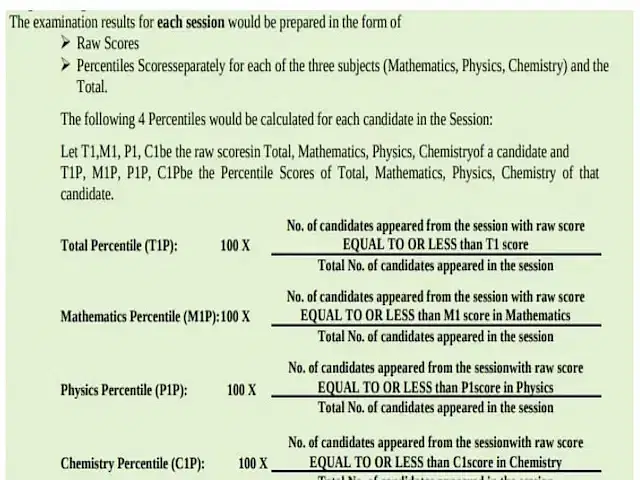
- It indicates the percentage of candidates who scored below or equal to the normalised score or a particular candidate in that session.
- The percentile scores can be calculated to 7 decimal places to ensure that each of you are allotted a unique ranking and there a fewer ties.
Consider the following examples to further understand the JEE Main 2026 percentile score calculation process:
Example 1:
The highest raw score and percentile score of JEE Main will be converted into a normalized percentile score of 100 for their respective session. Let us now understand this with the help of an example:
|
Session |
Total Number of Candidates (Present) |
Highest Raw Score |
Total Number of Candidates who Scored Equal to or Less Than the Highest Raw Score of a Candidate |
Applying the Above Formula |
|
Session 1 |
28012 |
335 |
28012 |
(28012/28012) X 100 = 100 |
|
Session 2 |
32541 |
346 |
32541 |
(32541/32541) X 100 = 100 |
Example 2:
The lowest raw score and percentile score of JEE Main will be calculated from the lowest raw scores and will depend on the total number of candidates who have taken the exam for the respective session:
|
Session |
Total Number of Candidates (Present) |
Lowest Raw Score |
Total Number of candidates who Scored Equal to or Less Than the Lowest Raw Score of a Candidate |
Applying the Above Formula |
|
Session 1 |
28012 |
-39 |
1 |
(1/28012) X 100 = 0.0035699 |
|
Session 2 |
32541 |
-38 |
1 |
(1/32541) X 100 = 0.0030730 |
Also Read: How Much Percentile is Good in JEE Main 2026?
Example 3:
In this hypothetical example, we will see the raw scores and percentile of students in a particular JEE Main session:
|
Candidates |
Raw Score by the Candidate |
Candidates who Scored Less than the Raw Score |
Total Number of Candidates Appeared for the Exam |
Percentile of the Candidate |
Explanation (Applying the above formula) |
|
1 |
335 |
28,000 |
28,012 |
99.9571612 |
(28000/28012) X 100 = 99.9571612 |
|
2 |
330 |
27,012 |
28,012 |
96.4301013 |
(27012/28012) X 100 = 96.4301013 |
|
3 |
310 |
20,000 |
28,012 |
71.3979722 |
(20000/28012) X 100 = 71.3979722 |
|
4 |
270 |
16,588 |
28,012 |
59.2174782 |
(16588/28012) X 100 = 59.2174782 |
|
5 |
230 |
13,999 |
28,012 |
49.9750107 |
(13999/28012) X 100 = 49.9750107 |
|
6 |
99 |
6,700 |
28,012 |
23.9183207 |
(6700/28012) X 100 = 23.9183207 |
|
7 |
58 |
400 |
28,012 |
1.42795944 |
(400/28012) X 100 = 1.42795944 |
Key Terms for Calculating JEE Main Percentile Score 2026
Understanding some key terms used to calculate the JEE Main percentile scores is crucial to getting an idea of how to calculate the score based on the raw marks. The key terms to understand how to calculate the JEE Main 2026 percentile score are mentioned below:
- Percentile Score: This score is based on the relative performance of candidates who have appeared for the exam. The percentile score is calculated by converting the total marks secured by you into a scale ranging from 100 to 0 for each examinee session.
- Normalisation Process: This process is used to compare the candidates' scores who have appeared in different shifts; this helps to derive a particular score.
- Highest Raw Score and Percentile Score: The highest raw score secured by you will be normalised to a 100 percentile score for each session they appear for. All the highest raw scores will be converted into normalised percentile scores of 100 for their respective session.
- Lowest Raw Score and Percentile Score: To calculate the lowest raw score, the total number of candidates appearing in the exam for each session is calculated. The percentile score for the lowest raw score is different.
What is the JEE Main Normalisation Process 2026?
The JEE exam is conducted across different shifts and exam centres across the country. Each paper set by the conducting body is also distinct in terms of difficulty level. So, to derive a solution and standardise the JEE Main marking system caused due to different shifts and varied question papers, the JEE Main normalisation process is used.
It ensures that you are neither benefited nor disadvantaged due to the difficulty level of the examination. The purpose is to serve justice and identify the true merit of each candidate.
The process of Normalisation is an established practice for comparing your scores across multi-session papers. This is similar to the process adopted in other national and state-level entrance tests conducted in India.
To understand the JEE Main normalisation process and how is JEE Main percentile score is derived further, let us take an example: The JEE Main exam is conducted in two sessions and two shifts each session. Here's the statistic for each session:
|
Session |
No. of Candidates Absent |
No. of Candidates Present |
Total Students |
Highest Marks |
Lowest Marks |
|
Session 1 (Day 1, Shift 1) |
3,974 |
28,012 |
31,986 |
335 |
-39 |
|
Session 2 (Day 1, Shift 2) |
6,189 |
32,541 |
38,730 |
346 |
-38 |
In the above example, we understand that the process to calculate the highest raw score will be normalized to 100; hence, indicating that 100% of candidates have obtained scores that are equal to or lesser than the highest scorer for that session.
Importance of JEE Main 2026 Normalisation of Scores
One of the crucial questions is "Why is the JEE Main normalisation process required?" How is it beneficial to you, if you are taking the exam? Here's why the JEE Main 2026 normalisation process is important:
- Ensures Fairness: Normalisation accounts for varying difficulty levels across multiple sessions, ensuring no candidate is unfairly advantaged or disadvantaged.
- Standardised Comparison: It converts raw scores into JEE Main percentile scores, enabling a uniform comparison of candidates' performance across sessions.
- Transparency: The process ensures transparency in rankings, helping you and institutions trust the fairness of the evaluation system.
- Equal Opportunity: Candidates compete on an equal footing, regardless of the session or shift in which they appeared.
- True Merit Identification: Normalisation highlights the true performance of candidates, enabling accurate identification of deserving students for admissions.
- Critical for Admissions: With intense competition, the normalised scores ensure fair ranking for admission to IIITs, GFTIs, and other top institutions, like NITs in India.
JEE Main Tie-Breaking Rules 2026
JEE Main 2026 results will be declared in March 2026, as the percentile score of the total raw score. In case two or more candidates attain equal percentile scores in the exam, the merit of such candidates shall be determined under the following order:
- The candidates obtained a higher percentile score in Mathematics as the first option.
- In case there is a clash of marks again, candidates achieving higher percentile scores in Physics are considered.
- If there is a situation of tie again, candidates attain a higher percentile score in Chemistry.
- If the problem is still not resolved, candidates older in age to be preferred.
Also Read: Minimum Marks in JEE Main to Qualify for JEE Advanced 2026
Expected JEE Main 2026 Marks vs Percentile Score
To anticipate the JEE Main 2026 percentile score, you can refer to the table provided below. This will help them understand their chances of admission to top engineering colleges in India:
| Marks (out of 300) | Percentile Range | Approximate Rank Range |
|---|---|---|
| 288 – 294 | 99.998 – 99.999 | 11 – 36 |
| 270 – 279 | 99.990 – 99.994 | 63 – 106 |
| 252 – 268 | 99.952 – 99.990 | 106 – 522 |
| 231 – 249 | 99.874 – 99.950 | 546 – 1,385 |
| 215 – 230 | 99.745 – 99.871 | 1,421 – 2,798 |
| 202 – 214 | 99.575 – 99.739 | 2,862 – 4,667 |
| 190 – 200 | 99.393 – 99.560 | 4,830 – 6,664 |
| 175 – 189 | 99.022 – 99.349 | 7,151 – 10,746 |
| 161 – 174 | 98.528 – 98.997 | 11,018 – 16,163 |
| 149 – 159 | 98.075 – 98.498 | 16,495 – 21,145 |
| 132 – 148 | 97.011 – 97.975 | 22,238 – 32,826 |
| 120 – 131 | 96.069 – 96.937 | 33,636 – 43,174 |
| 110 – 119 | 95.056 – 95.983 | 44,115 – 54,293 |
| 102 – 109 | 94.012 – 94.967 | 55,269 – 65,758 |
| 95 – 101 | 93.056 – 93.899 | 66,999 – 76,260 |
| 89 – 94 | 92.058 – 92.887 | 78,111 – 87,219 |
| 79 – 88 | 90.045 – 91.792 | 90,144 – 109,329 |
| 62 – 87 | 84.562 – 91.595 | 92,303 – 169,542 |
| 41 – 61 | 70.268 – 84.225 | 173,239 – 326,517 |
| 1 – 42 | 6.666 – 69.580 | 334,080 – 1,025,009 |
Also Read: How to Calculate JEE Main Rank 2026 from Percentile?
Now that you have learned how to calculate the JEE Main 2026 percentile score, it will be easier for them to mark themselves and know where they stand in the pool of competition. You will also get a fair idea of what to expect from the JEE Main 2026 paper.





![Indian Institute of Technology, [IIT] Kanpur](https://media.getmyuni.com/azure/college-image/small/indian-institute-of-technology-iit-kanpur.jpg)
![Indian Institute of Technology, [IIT] Roorkee](https://media.getmyuni.com/azure/college-image/small/indian-institute-of-technology-iit-roorkee.jpg)
![Jawaharlal Nehru University, [JNU] New Delhi](https://media.getmyuni.com/azure/college-image/small/jawaharlal-nehru-university-jnu-new-delhi.jpg)
![University of Calcutta, [UC] Kolkata](https://media.getmyuni.com/azure/college-image/small/university-of-calcutta-uc-kolkata.jpg)

























POST YOUR COMMENT