
Table of Contents
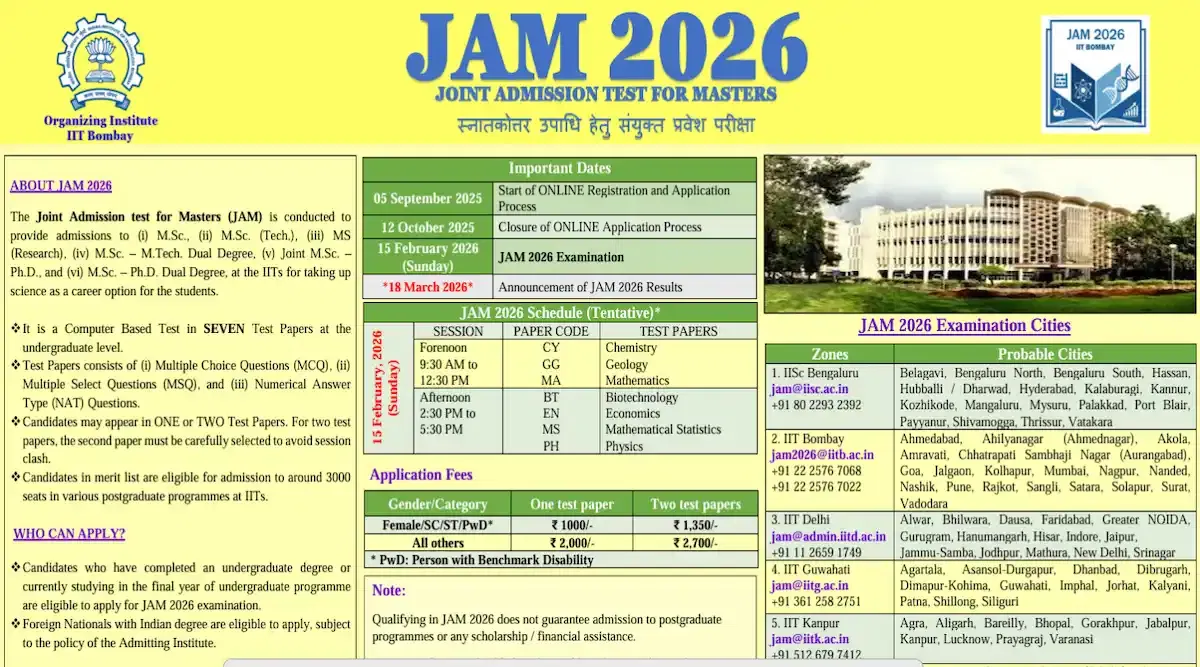
The IIT JAM (Joint Admission Test for Masters) is a nation-level admission test that is given for admission to M.Sc., Joint M.Sc.-Ph.D., and other postgraduate science programs in prominent institutes such as the Indian Institutes of Technology (IITs), Indian Institute of Science (IISc), and National Institutes of Technology (NITs). Among the many subjects offered, Geology (GG) is one of the preferred choices among students who have a background in Earth sciences.
IIT JAM 2025 Geology Syllabus
The syllabus for IIT JAM 2025 Geology is broadly divided into the following major sections. Apart from this, you must check the PDF link given below and download the IIT JAM 2025 Geology syllabus as released by the conducting authority.
| IIT JAM 2025 Geology Syllabus | PDF Link |
The Planet Earth
- Origin of the Solar System and the Earth.
- Internal structure of the Earth.
- Earth’s magnetic field and paleomagnetism.
- Plate tectonics.
- Earthquakes and seismic waves.
- Geological time scale.
- Age of the Earth.
- Radioactivity and age dating of rocks.
Tip: Learn to recognize the dynamic character of the Earth and phenomena such as seafloor spreading, continental drift, and isostasy.
Geomorphology
- Basic concepts of geomorphology.
- Weathering, erosion, and soil formation.
- Landforms created by fluvial, glacial, eolian, coastal, and karst processes.
- Slope development.
- Geomorphic cycles.
Tip: Read about the processes and their effects on landscape evolution as well as diagrammatic representation of landforms.
Structural Geology
- Stress and strain in rocks.
- Folds, faults, joints, and foliations.
- Geological maps and cross-sections.
- Stereographic projections.
- Mohr’s circle and its applications.
Tip: Practice interpreting geological maps and cross-sections frequently, as these are commonly tested.
Paleontology
- Fossilization processes.
- Morphology and classification of major invertebrates (trilobites, brachiopods, mollusks, etc.).
- Evolutionary trends.
- Gondwana flora.
- Vertebrate paleontology.
- Micropaleontology basics.
Tip: Note the index fossils and their geological time span, as they are significant for age correlation.
Stratigraphy
- Principles of stratigraphy.
- Stratigraphic classification and nomenclature.
- Geological time scale.
- Indian stratigraphy: Dharwar, Cuddapah, Vindhyan, Gondwana, Deccan Traps, Siwalik, etc.
- Sequence stratigraphy and basin analysis.
Tip: Lay emphasis on lithostratigraphic, biostratigraphic, and chronostratigraphic features and their correlation methods.
Mineralogy
- Crystal chemistry.
- Crystal symmetry and classification.
- Physical and chemical properties of minerals.
- Optical mineralogy.
- Classification of silicates.
- Important rock-forming mineral groups: Feldspars, pyroxenes, amphiboles, micas, olivine, garnet, etc.
Tip: Practice identification of minerals using polarizing microscopes and hand specimens.
Petrology
- Igneous rocks: Classification, textures, structures, phase diagrams (binary and ternary).
- Sedimentary rocks: Classification, texture, sedimentary structures, depositional environments.
- Metamorphic rocks: Textures, structures, metamorphic facies and grades, P-T-t paths.
Tip: Learn about processes of rock formation and classification from field samples and thin sections.
Economic Geology
- Ore genesis.
- Classification of mineral deposits.
- Magmatic, hydrothermal, sedimentary, and metamorphic processes of mineral formation.
- Indian mineral deposits: Iron, manganese, copper, gold, lead-zinc, coal, petroleum, and natural gas.
Tip: Emphasize the processes and geological environments of large-scale Indian ore deposits.
Applied Geology
- Engineering properties of rocks and soils.
- Geological investigations for civil engineering projects like dams, tunnels, and reservoirs.
- Landslides and their mitigation.
- Remote sensing and GIS: Principles and applications in geological studies.
Tip: Read about actual applications of geology and fundamental techniques in environmental and civil engineering applications.
Hydrogeology
- Hydrologic cycle.
- Aquifers: Types, properties, and classifications.
- Groundwater movement and flow equations.
- Water table and piezometric surfaces.
- Well hydraulics and groundwater exploration.
Tip: Read about groundwater modeling and interpretation based on hydrological data and maps.
Exam Pattern for IIT JAM 2025 Geology
You need to understand the IIT JAM exam pattern to prepare better and perform more efficiently in the exam. You can refer to the table given below to get an overview of the IIT JAM 2025 Geology paper structure:
| Section | Type of Questions | Number of Questions | Marks |
| A | Multiple Choice Questions (MCQ) | 30 (1 or 2 marks) | 50 |
| B | Multiple Select Questions (MSQ) | 10 (2 marks) | 20 |
| C | Numerical Answer Type (NAT) | 20 (1 or 2 marks) | 30 |
| Total | — | 60 Questions | 100 Marks |
- Duration: 3 hours
- Mode: Online Computer-Based Test (CBT)
- Negative Marking: Only in Section A (MCQs). No negative marking in MSQ and NAT.
Preparation Strategies for IIT JAM Geology 2025
The IIT JAM Geology (GG) paper consists of both theoretical concepts and clear understanding, as well as having a sound problem-solving skill. Preparation for it requires a thoughtful approach with syllabus acquaintance, typical resources, regular practice, and revision. Below is the detailed analysis of how to prepare intelligently and effectively for IIT JAM Geology:
- Familiarize yourself with the Syllabus and Exam Pattern
- The understanding of the syllabus is the initial and most important step in your preparation. Divide the syllabus into small, manageable pieces and map them to a weekly or monthly study plan.
Tip: Pay greater emphasis on high-weightage topics such as Structural Geology, Mineralogy, Petrology, and Paleontology in the early phases of your preparation.
- Use Standard Books
Selecting good study material is instrumental to grasping basic and advanced concepts. Below is a list of suggested books for each section:
| Name of Book | Name of Author |
| Principles of Physical Geology | Arthur Holmes |
| Structural Geology | Billings |
| Principles of Paleontology | Raup and Stanley |
| Manual of Mineralogy | Dana |
| An Introduction to the Rock-Forming Minerals | Deer, Howie & Zussman |
| Petrology | G.W. Tyrrell |
| An Introduction to Igneous and Metamorphic Petrology | John D. Winter |
| Economic Mineral Deposits | Jensen & Bateman |
Tip: Do not attempt to read all books from front to back. Target key chapters corresponding to important JAM syllabus topics.
- Make Short Notes and Diagrams
- Short notes are your strongest revision tools. During reading books or lectures:
- Make short notes topic-wise.
- Summary theories, classifications, and definitions.
- Make flowcharts for processes (e.g., rock cycle, mineral formation).
- Visualize complex structures such as folds, faults, and terrains using colored maps, geological cross-sections, and block diagrams.
Tip: Sticky notes and flashcards for main concepts. This aids in rapid revision nearer to the exam.
- Practice Previous Year Papers
- Practicing a minimum of 5–7 years of previous JAM Geology papers is necessary to:
- Get familiar with the types of questions framed.
- Understand the level of difficulty.
- Know major and repeated topics.
- While practicing:
- Tim yourself to replicate real exam conditions.
- Go over your solutions and mark weak areas.
- See the weightage assigned to each subject.
Tip: Classify questions as easy, moderate, and difficult, and rework the challenging ones several times.
- Practice Mock Tests
- After gaining a reasonable grasp over the syllabus, it's time to verify your preparation with mock tests.
- Subscribes to a trusted test series tailored exclusively for IIT JAM Geology.
- Take full-length online mocks every 10–15 days.
- Evaluate your accuracy, speed, and time management.
- Identify repetitive mistakes and fine-tune your strategy.
- Mock tests improve:
- Confidence
- Mental stamina for the 3-hour paper
- Adaptability to unpredictable question patterns
Tip: Try solving the mock using the same exam interface (if available) as the actual JAM CBT environment.
- Revise Regularly
- Revision is the key to retention. It ensures that the concepts remain fresh in your mind and helps reinforce your memory.
- Use the last 2 months solely for revision.
- Revise your short notes, formulae, and diagrams several times.
- Put extra emphasis on weak and tough topics.
- Resist the temptation of selecting new topics at the time of final revision.
- Prepare a revision schedule and systematically cover all key chapters. Divide your revision into:
- 2-hour slots in daily schedule for rapid review
- Weekly revisions for complete topics
- Monthly mock review and correction of errors
- Tip: Group discussion or study with classmates can help remove doubts and provide new insights.