
A good score in GATE 2026 is 90 and above to secure a GATE rank between 1-10. A GATE score also depend on factors such as the subject the candidates appeared for, the category, branch and the performance.

Table of Contents
What is a Good GATE Score 2026? A score above 90 is considered a good GATE score 2026 for admission into various courses. However, the scores vary for each branch. Scores for the GATE exam are finalised by applying the normalisation process. The GATE normalisation process is a method employed to derive the scores for the exam that is conducted in multiple sessions. Additionally, employing this process ensures that it is unbiased and that the scores are perfect.
The GATE 2026 exam is conducted for 30 subjects, and the scores for each subject are expected to differ. However, a good score in GATE is important for admission to top universities and IITs. The Indian Institute of Technology Roorkee conducts the GATE 2026 exam for admissions into M.Tech courses. Moreover, a good GATE score for PSU is important for recruitment.
What is a Good GATE Score 2026?
A good score in GATE is a variant for each category. So the candidates wondering what is a good GATE 2026 score must know that they need to score 90+ to get a good rank. GATE score is also required to obtain a seat in research facilities, pursue a PhD program, and Fellow Programme in Management (FPM), a doctoral programme offered by many of the top IIMs in India.
Given below is the expected GATE mark vs rank 2026:
|
Rank |
GATE Marks (Out Of 100) |
|
1-10 |
85-100 |
|
10-50 |
82-87 |
|
50-100 |
80-85 |
|
100-200 |
78-83 |
|
200-500 |
76-81 |
|
500-1000 |
74-79 |
|
1000-2000 |
72-77 |
|
2000-5000 |
70-75 |
|
5000-10000 |
60-65 |
GATE Score Calculation Process 2026
Depending on the number of sessions for which the GATE exam was conducted, the GATE scores are calculated. Suppose the exam was administered over two sessions.
In that case, the raw scores will be converted to normalised scores to determine the final score. The raw scores are considered the final scores for the exam conducted for a single session. Nonetheless, the good GATE score for PSU is calculated by individual institutes for admissions.
How are GATE Scores Calculated Using Normalised Process?
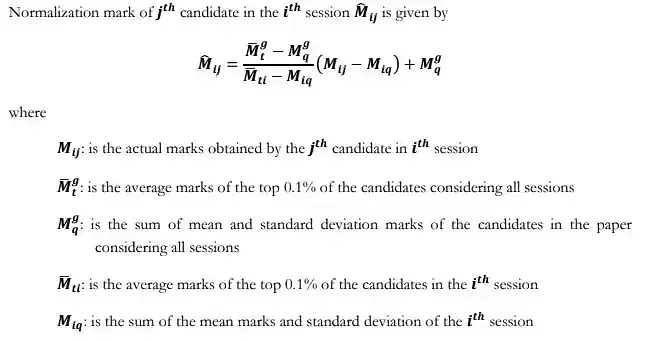
For the GATE 2026 exam, when multiple-session paper exams are held, the formula to normalise these papers’ scores is incorporated. It depends on various factors such as their difficulty level, the total number of questions in the exam, and the raw scores.
Given below is the formula used to derive the GATE normalised score:
Read More: GATE Normalisation Process 2026
How to Download GATE Score Card 2026?
The process to download the GATE scorecard is simple. The steps below have been explained. Candidates must keep all their login credentials ready for easy access.
- Candidates must visit the official website of GATE 2026.
- Next, they will spot the GATE Score Card 2026 link in the notification section. They must click on the link.
- The page will be redirected to the scorecard. Candidates must enter their login credentials.
- The scores will be displayed on the screen. Candidates must check the details and download them.
Note: Candidates can access and download the GATE 2026 scorecards till December 2026 by paying an additional fee of INR 500.
Details mentioned in the GATE Score Card 2026
The GATE scorecard 2026 will display the following details of the candidate. Additionally, candidates are requested to check all the particulars before downloading the scorecard.
- Name and photograph of the candidate
- Gender of the candidate
- GATE 2026 registration number
- GATE paper the candidate appeared for
- Obtained score (calculated out of 1000)
- Total Marks obtained out of 100 (Raw score)
- GATE 2026 Score Card Validity
- All India Rank
- Qualifying Marks (Category-wise).
Also Check: GATE Score Validity 2026
GATE Previous Year’s Qualifying Scores
Candidates looking for what is a good score in GATE must get a clear picture by referring to the table below. The GATE qualifying scores of the previous years are mentioned here. The GATE previous year qualifying marks can be used to review past trends and calculate the expected scores.
| GATE Exam | GATE Qualifying Scores | ||
| General | OBC-NCL/ EWS | SC/ST/PwD | |
| 2025 | |||
| CS | 27.6 | 24.28 | 18.4 |
| ECE | 28.3 | 35.0 | 18.8 |
| Biotechnology | 38.9 | 25.0 | 25.9 |
| Chemical Engineering | 25.0 | 22.5 | 16.6 |
| Statistics | 26.6 | 23.9 | 17.7 |
| Metallurgical engineering | 41.0 | 36.9 | 27.3 |
| Mathematics | 25.0 | 22.5 | 16.6 |
| Electrical engineering | 25.7 | 23.1 | 17.1 |
| Textile engineering and fibre science | 28.1 | 25.2 | 18.7 |
| Mechanical Engineering (ME) |
28.6 |
25.7 | 19.0 |
| Physics | 32.0 | 28.8 | 21.3 |
| Life Science (Botany/ Zoology) | 29.3 | 26.3 | 19.5 |
| Ecology and life sciences | 35.8 | 32.2 | 23.8 |
| Agriculture Engineering | 25.0 | 22.5 | 16.6 |
| Chemistry | 25.2 | 22.6 | 16.7 |
| Mining Engineering | 25.0 | 22.5 | 16.6 |
| Engineering Sciences (Fluid Mechanics/ Thermodynamics) | 36.2 | 32.5 | 24.1 |
| 2024 | |||
| CS | 25 | 22.5 | 16.6 |
| ECE | 25 | 22.5 | 16.5 |
| Biotechnology | 35.5 | 31.9 | 23.6 |
| Chemical Engineering | 25.3 | 22.7 | 16.8 |
| Statistics | 25 | 22.5 | 16.6 |
| Metallurgical engineering | 46.2 | 41.5 | 30.8 |
| Mathematics | 27.3 | 24.5 | 18.2 |
| Electrical engineering | 30.7 | 27.6 | 20.4 |
| Textile engineering and fibre science | 36.8 | 34.9 | 25.6 |
| Mechanical Engineering (ME) | 28.1 | 25.2 | 18.7 |
| Physics | 26.5 | 23.8 | – |
| Life Science (Botany/ Zoology) | 33.9 | 30.5 | 22.5 |
| Ecology and life sciences | 33.4 | 30 | 22.2 |
| Agriculture Engineering | 26.3 | 23.6 | 17.5 |
| Chemistry | 27.5 | 24.7 | 18.3 |
| Mining Engineering | 25.5 | 22.9 | 17 |
| Engineering Sciences (Fluid Mechanics/ Thermodynamics) | 40.3 | 36.2 | 26.8 |
| 2023 | |||
| Geology and Geophysics | 44.8 | 40.3 | 29.8 |
| Civil Engineering | 29.2 | 26.2 | 22.0 |
| Biotechnology | 30 | 27 | 20 |
| Mechanical Engineering | 33 | 29.7 | 22 |
| Textile Engineering and Fibre Science | 41.8 | 37.6 | 27.8 |
| Chemistry | 36.2 | 32.5 | 24.1 |
| Mathematics | 29 | 26.1 | 19.3 |
| Electrical Engineering | 30.3 | 27.2 | 20.2 |
| Computer Science | 26.1 | 23.4 | 17.4 |
| Electronics and Communication | 25 | 22.5 | 16.6 |
| Humanities and Social Sciences | 37.9 | 34.1 | 25.2 |
| Instrumentation Engineering | 36.0 | 32.0 | 24.0 |
| 2022 | |||
| Life Sciences | 31.7 | 28.5 | 21.1 |
| Civil Engineering | 32.9 | 29.6 | 21.9 |
| Electrical Engineering | 33.4 | 30.0 | 22.2 |
| Computer Science and Information Technology | 28.5 | 25.6 | 19.0 |
| Mechanical Engineering | 34.0 | 30.6 | 22.6 |
| Petroleum Engineering | 39.8 | 35.8 | 26.5 |
| Electronics and Communication Engineering | 28.8 | 25.9 | 19.2 |
| Chemical Engineering | 35.7 | 32.1 | 23.8 |
| Chemistry | 26.7 | 24.0 | 17.8 |
| Biotechnology | 30.7 | 27.6 | 20.4 |
| Engineering Sciences Minor | 26.0 | 23.4 | 17.3 |
| Textile Engineering and Fibre Science | 37.1 | 33.3 | 24.7 |
| Aerospace Engineering | 27.2 | 24.4 | 18.1 |
| Agricultural Engineering | 26.3 | 23.6 | 17.5 |
| Architecture and Planning | 34.8 | 31.3 | 23.2 |
| Ecology and Evolution | 42.2 | 37.9 | 28.1 |
| Geology | 38.4 | 34.5 | 25.6 |
| Geophysics | 51.9 | 46.7 | 34.6 |
| Instrumentation Engineering | 34.6 | 31.1 | 23.0 |
| Mathematics | 25 | 22.5 | 16.7 |
| Mining Engineering | 32.7 | 29.4 | 21.8 |
| Metallurgical Engineering | 49.2 | 44.2 | 32.8 |
| Physics | 37.2 | 33.4 | 24.8 |
| Production and Industrial Engineering | 36.6 | 32.9 | 24.4 |
| Statistics | 25 | 22.5 | 16.6 |
| Biomedical Engineering | 25.0 | 22.5 | 16.6 |
Also Check: GATE 2026 Question Paper with Solutions






![Indian Institute of Technology, [IIT] Bombay](https://media.getmyuni.com/azure/college-image/small/indian-institute-of-technology-iit-bombay.jpg)

![Indian Institute of Technology, [IIT] Kanpur](https://media.getmyuni.com/azure/college-image/small/indian-institute-of-technology-iit-kanpur.jpg)
![Indian Institute of Technology, [IIT] Kharagpur](https://media.getmyuni.com/azure/college-image/small/indian-institute-of-technology-iit-kharagpur.jpg)























POST YOUR COMMENT