Download the IIT JAM 2026 Chemistry Question Bank PDF with answers. Practice the most repeated, high-weightage questions from Physical, Organic & Inorganic Chemistry to boost your score.
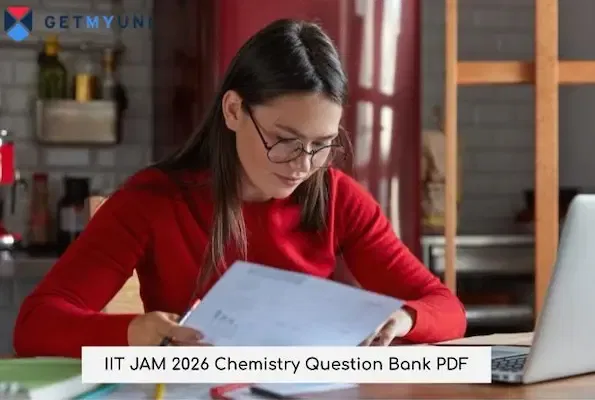
Table of Contents
Understanding the concepts is only one aspect of preparing for the IIT JAM exam, another is being familiar with the kinds of questions that are commonly asked. Because of their conceptual significance and practicality, some questions and subjects have frequently surfaced in the test over the years.
We have identified the top 30 frequently asked, high-weighted questions in the IIT JAM Chemistry section by examining IIT JAM previous year papers from 2023, 2024, and 2025. This compilation will help you increase your accuracy, concentrate on the important things, and get the most out of your next test.
IIT JAM Chemistry Repeated Questions
You can check a few IIT JAM Chemistry Repeated Questions to get an overview of high weightage questions and understand the IIT JAM exam pattern
Question 1:
Which of the following is a correct thermodynamic relation?
(A) ΔG = ΔH - TΔS
(B) ΔS = q_rev / T
(C) ΔG = -RT ln K
(D) ΔU = q - w
Correct Answer: (A), (B)
Question 2:
Ratio of collision frequency between A-A and A-B particles of equal molar quantities is:
(A) 1:1
(B) 2√2:1
(C) √2:1
(D) 2:1
Correct Answer: (B)
Question 3:
Which titration curve corresponds to a dibasic acid?
(A) s-curve
(B) flat-sigmoid
(C) double inflection
(D) step-curve
Correct Answer: (C)
Question 4:
Viscosity of a liquid generally:
(A) Increases with temperature
(B) Decreases with temperature
(C) Remains constant
(D) First increases then decreases
Correct Answer: (B)
Question 5:
What is the work done during an isothermal expansion of 1 mol ideal gas from 1L to 10L at 300K?
(A) 1.7 J
(B) 17 J
(C) 1.7 kJ
(D) 170 J
Correct Answer: (C)
Question 6:
What volume of 0.1 M NaOH is needed to titrate 20 mL of 0.1 M H₂SO₄?
(A) 10 mL
(B) 20 mL
(C) 40 mL
(D) 200 mL
Correct Answer: (C)
You can explore more such questions by clicking the PDF download link available in the table below
| Particulars | Details |
| IIT JAM Chemistry Repeated Questions | PDF Link |
IIT JAM Chemistry Topic-Wise Weightage
For effective preparation, it is crucial to comprehend the topic-by-topic weighting in the IIT JAM syllabus. Physical, organic, and inorganic chemistry are the three main topics covered in the IIT JAM Chemistry exam, and each one adds in a unique way to the final product.
This comprehensive review of IIT JAM Chapter-wise weightage will assist you in concentrating on the most important factors for achieving high scores.
| Topics | Weightage |
| Thermodynamics, Quantum Chemistry, Kinetics, Electrochemistry, Solid State, Surface Chemistry | 35-40% |
| Reaction Mechanism, NMR/IR Spectroscopy, Named Reactions, Stereochemistry, Aromatic Compounds | 30-35% |
| Coordination Compounds, Periodic Properties, Organometallics, Bioinorganic, Main Group Chemistry | 25-30% |
Why Practicing from the IIT JAM Chemistry Question Bank Boosts Your Score?
Practicing with an IIT JAM Chemistry question bank is one of the smartest ways to prepare for the exam. It helps you focus on frequently asked questions, improve speed, and strengthen your conceptual understanding of the IIT JAM exam pattern.
- Understanding of the Exam Pattern: You can better grasp the format, question types, and degree of difficulty of the real exam by regularly practicing with a question bank.
- Covers Frequently Asked Questions: Every year, a large number of JAM Chemistry questions share conceptual similarities. High-weighted, frequently asked questions in a good question bank improve your chances of getting a higher score.
- Enhances Conceptual Clarity: You strengthen your foundations by practicing topic-wise questions that reinforce fundamental ideas in physical, organic, and inorganic chemistry.
- Boosts Accuracy and Speed: Frequent timed practice helps you improve time management and cut down on careless errors, two things that are essential for acing competitive exams.
- Self-Evaluation and Revision: Frequently, question banks include thorough answers that let you assess your performance, pinpoint your areas of weakness, and concentrate.
Conclusion
In summary, cracking the IIT JAM 2026 Chemistry exam is less about rote memorization and more about mastering the application of concepts across Physical, Organic, and Inorganic branches. By consistently utilizing a structured Question Bank and analyzing the nuances of the MSQ and NAT sections, you can significantly reduce exam-day anxiety and improve your accuracy. Remember, the journey to an IIT or IISc begins with a single solved paper. Stay disciplined, keep your resources streamlined, and use your practice PDFs not just as tests, but as diagnostic tools to identify and bridge your learning gaps.





POST YOUR COMMENT