
Discover how DPUSOD nurtures human-centered designers through empathy, collaboration, and experience-led learning to create products and services people truly love.
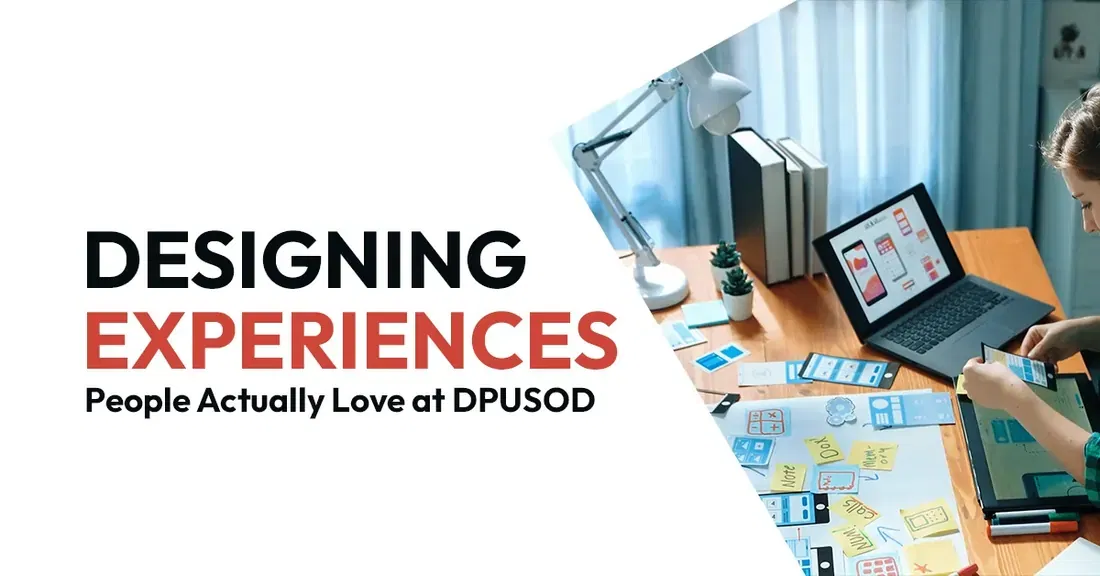
Table of Contents
In a world overloaded with products, apps, spaces, and services, what truly sets something apart is not just how it looks, but how it feels. At D.Y. Patil School of Design, students aren’t just taught to create things; they are trained to craft memorable experiences that delight, engage, and connect with real people in real life. Design, here, is not a discipline; it’s a philosophy, a way of sensing the world, and shaping it in meaningful ways.
With every studio project, workshop, critique, and collaboration, the institute pushes its students to think beyond aesthetics and technical skills to deeply understand the humans they’re designing for. This isn’t about trends or flashy visuals; it’s about empathy, curiosity, and intentional problem-solving. Among the many B.Des colleges in Pune, it stands out for its strong focus on experience-led, human-centric design education.
Let’s dive into how the institute is shaping designers who don’t just make things but design experiences people actually love.
Empathy as the Heartbeat of Design
At the core of every successful experience is empathy, the ability to see the world through someone else’s eyes. The champions of this institute believe in every step of its curriculum. From the very first semester, students are introduced to human-centered design thinking, where the challenge is never just “What do I want to make?” but “What does someone else truly need?”
Imagine a student tasked with redesigning the local bus stand. Rather than jumping straight to sketching futuristic benches or glossy signboards, the first assignment is simple: go observe. They spend hours watching commuters, talking to vendors, noting pain points and joyful moments alike. They feel the scorching sun at noon, hear the announcements in a cacophony of horns, and witness how a mother with groceries navigates the steps.
This empathetic immersion teaches something invaluable: experiences are shaped not in isolation, but through real lives and stories. The result? Designs that aren’t just visually appealing, but genuinely useful and resonant, a transport hub that becomes easier to use, safer, and even pleasant because it was crafted with human needs at its heart.
Creative Processes That Celebrate Curiosity
Design at this institute isn’t a rigid formula; it’s a playground for curiosity. Students are encouraged to ask bold questions, experiment fearlessly, and embrace failure as a stepping stone toward better solutions. The culture here beams with energy: studios buzzing with sketches pinned to walls, animated debates over user insights, and the joyful chaos of prototyping materials scattered across tables.
What makes this environment special is how it blends imagination with structure. Workshops in storytelling, visual communication, interaction design, and cultural studies give students tools to frame their ideas thoughtfully. Simultaneously, open-ended briefs challenge them to apply those tools in inventive ways. One day, they might be designing a mobile experience to teach sustainable habits; the next, they could be reimagining a traditional craft form for urban markets. Across all projects, the guiding question remains: How will this make people feel?
This exploratory mindset creates designers who are not simply executors of briefs, but thoughtful creators, capable of weaving emotion, function, and context into cohesive, engaging experiences.
Collaboration: Where Ideas Spark Fire
Great design rarely happens in isolation, and the institute thrives on collaborative energy. Students work closely with peers from diverse creative streams: product designers, visual communicators, UX/UI thinkers, fashion innovators, and spatial designers. This cross-pollination of perspectives leads to richer thinking and unexpected solutions.
Imagine a team blending a fashion student’s understanding of human movement with a product designer’s insight into ergonomics. Together, they create a wearable tech concept that not only looks stylish but also enhances everyday comfort. Or a UX group partnering with spatial designers to create an interactive exhibition where digital and physical worlds blur seamlessly.
What sets this school apart is its belief that design is collective. Every critique session is a learning moment where peers challenge each other to refine, justify, and elevate their work. Faculty mentors guide with gentle provocation, not by giving answers, but by helping students discover them for themselves. In this environment, ideas don’t just grow, they ignite.
What Students Learn?
- Human-Centered Design Thinking: From observations to ideation, students learn to put people first, understanding needs before solutions.
- Prototyping & Iteration: Quick sketches, digital mockups, and physical models are used to test ideas early and often.
- Storytelling & Communication: Narratives are used to make designs understandable and emotionally compelling.
- Interdisciplinary Collaboration: Projects often bring together diverse domains, enhancing creative problem-solving.
- Real-World Engagement: Live briefs with community partners and industry collaborators ensure learning stays grounded in reality.
The Experiences They Create
- Designing Community Spaces that improve social interaction and accessibility for local neighborhoods.
- User-Friendly Apps & Services for seniors, students, and commuters, crafted after deep user research.
- Interactive Exhibits that blend technology with cultural storytelling engage audiences of all ages.
- Sustainable Product Concepts that reinterpret traditional materials for modern usage.
- Social Impact Campaigns that raise awareness on issues like mental health, mobility challenges, and environmental care.
Final Words: Design Education That Resonates Beyond Graduation
What makes the experience at D.Y. Patil School of Design truly impactful is not only what students make but also how they think. Graduates leave with the confidence to navigate ambiguity, the sensitivity to understand diverse perspectives, and the ability to create with purpose.
In a world where consumers are increasingly drawn to products and services that feel human, designers who can build meaningful experiences are invaluable. Whether it’s a digital platform that anticipates needs, a public space that invites connection, or a product that enhances daily joy, the designers from this school carry forward a legacy: design that cares.
And perhaps that’s the most powerful takeaway: design isn’t just about shaping objects or screens; it’s about shaping moments, interactions, and memories that people love.








































POST YOUR COMMENT