An interview is a formal and structured conversation between the interviewer and the interviewee. It is a selection procedure that aids employers in understanding your skills, qualifications and traits to scrutinize your suitability for the job.
An interview is a formal and a structured conversation between two or more people where one person shall ask question from the other contestant. The interviewer is sometimes a single person or a panel questioning you. It is conducted to get knowledge about you and assess your qualification and other skills. Based on the interview report, your final merit is prepared. If the interviewer is satisfied with your responses and personality, you will be offered the job role.
If you're preparing to enter the job market or applying for college admissions, chances are you'll face an interview. Interviews are a key part of the selection process—whether for a job, an internship, a course, or even a research role. Understanding what an interview is, its types, objectives, and how to introduce yourself in an interview?
Definition of an Interview
An interview is a formal, structured conversation where one party—usually an employer, academic institution, or recruiter—asks questions, and you respond with your answers. The goal is to assess your suitability for a role or position.
In simple terms, an interview is a two-way communication that helps the interviewer evaluate your knowledge, skills, experience, personality, and potential, while you get a chance to learn about the organization or opportunity.
Objectives of Interview
When you walk into an interview, you’re not just answering questions—you’re part of a selection process designed to achieve specific goals. Here's what an interview is meant to do:
- Assess your technical and soft skills relevant to the job or role
- Evaluate your personality and behavior to see if you’re a cultural fit
- Understand your motivation and interest in the position
- Clarify information from your resume, application, or previous experiences
- Provide an opportunity for you to ask questions and learn more about the organization
Also Read: How to Explain Project in an Interview?
What are the Types of Interviews?
There are different interview types, depending on the scenario or situation in which and for which it is being conducted. The types of interviews can be categorized into the following:
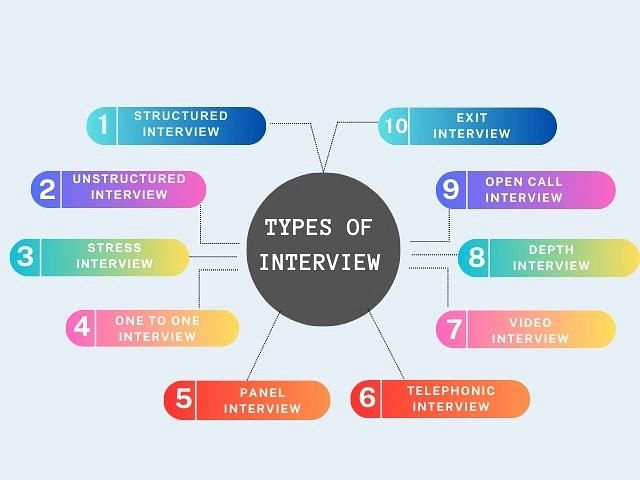
1. Structured Interview
It is the traditional form of an interview. Preset standardized questions are asked of the interviewee and are the same for all of you. It is the kind of interview that gives the chance to examine all your skills and abilities impartially. The questions also help the interviewer compare the responses and choose the best one.
2. Unstructured Interview
It is just the opposite of structured interviews. It is a free-flowing conversation. This type of interview is also known as Informal interview. The interviewer already has a definite idea in mind about the questions to be asked. Generally, questions are made up during the interview as per your responses. An unstructured interview does not follow any formal rules and procedures.
3. Stress Interview
These kinds of interviews are very rare. Here, the interviewer puts the interviewee under a stressful situation to test their presence of mind. A stress interview also tests how the interviewee manages the crisis at a given time. The interviewer tends to make the interviewee nervous by asking tons of questions at the same time. It is done to see whether the candidate can cope with a crisis and not panic.
4. One to One Interview
It is a general type of interview. There are just two persons, i.e., the interviewer and the interviewee, and a formal, face-to-face discussion takes place, assessing the candidate's skills and abilities. The interviewer asks general and technical questions to check the suitability for a position.
5. Panel Interview
A panel interview is known as a board interview. This type of interview takes place between one candidate and a panel of members of the company, usually more than two. Each one gives different scores to you and combines them to see if you have qualified. Notably, you are often victims of personal biases in a panel interview, and it is not feasible for organizations that take many interviews daily.
6. Telephonic Interview
Telephonic interviews are conducted over the phone and are economical and less time-consuming. The company can select promising individuals for the job through these interviews. Its main objective is to limit the list of candidates and appoint the best ones. These are more accurate than one-to-one interviews for judging interviewees' intelligence and interpersonal skills. You are usually surprised by the unexpected call from the recruiter. However, these calls can surprise you and they are likely to panic. Moreover, answers are to be given in a restricted time.
7. Video Interview
One of the newest forms of interviews is conducted through various video conferences, online chats, or messaging due to their rapidity and inexpensiveness. It saves time and money. The best part of these interviews is that both the interviewer and interviewee need not be in the same place, not even the same continent. It is just like a personal interview, where the recruiter informs the candidate about the interview a few hours before the scheduled time. These interviews are done if the interviewee lives far off and cannot make it to the interviewer's place for valid reasons.
8. Depth Interview
As the term itself says, it distinguishes the interviewee in-depth. These are detailed and discovery-oriented.
- It covers the candidate's life history, academic qualifications, interests, hobbies, and professional work experience.
- The interviewer here is a listener and wants to know the candidates in detail, allowing more time and a free flow of conversation and making a friendly approach.
9. Open Call Interview
Open-call interviews, most commonly known as walk-in interviews, are conducted on the spot. The questions are not present; they vary according to the candidates' responses. Most of these types of interviews are for seasonal or temporary job roles.
10. Exit Interview
These interviews are conducted with company employees when they are leaving their jobs. In this interview, the employee is expected to deliver an honest review of his experience in the firm. Its main purpose is to give the person leaving a good feeling and take their suggestions.
Also Read: 25 Best IAS Interview Questions and Answers
Types of Interview Formats
Researching different interview formats will help the candidates prepare better for their forthcoming interview. Here are some interview formats:
- Structured Interview
All candidates are asked the same set of questions. It's objective and easier to compare answers. - Unstructured Interview
The interviewer may ask questions as the conversation flows. It’s more casual but less predictable. - Semi-Structured Interview
A mix of set questions and follow-ups, providing a balance between structure and flexibility.
Also Read: Top 25 Bank Interview Questions and Answers
Why are Interviews Important?
Interviews aren’t just hurdles to jump over—they serve valuable purposes for both you and the interviewer. Here's why interviews are a crucial part of the selection procedure:
- Interviews play a crucial role in the selection process of the favourable candidate. They help the interviewer choose who is efficient and who is not.
- Resumes do not present a clear picture or inabilities of a candidate; recruiters get to know the candidate's weaknesses and where they need training through the interview procedure.
- Interviews are a necessary strategy to know a candidate's potential to perform tasks at the workplace and anticipate their professional behaviour.
- Through the interviewing process, the employer and the interviewee get to know each other, essential information flows, and all doubts are freed.
- The employer gets to know about the interviewee's actual communicative skills and checks their general skills of writing and speaking through the quality of their responses.
- Employers also learn about the candidate's individuality and personality. They analyze their social behaviour and confidence in their body language.
Also Read: Popular Scholarship Interview Questions
Interview Preparation Tips for Freshers
If a fresher facing an interview for the first time is nervous about how to present oneself during the interview, they can follow the below-mentioned tips:
As a fresher, interviews can feel intimidating. But with preparation and confidence, you can make a great impression. Here are some tips to help you succeed:
- Know the Company or Institution
- Research their mission, values, services, or academic offerings. This shows genuine interest.
- Review the Job or Course Description
- Understand what’s expected from the role or program so you can align your answers.
- Practice Common Interview Questions
- Rehearse answers to questions like:
- "Tell me about yourself"
- "Why should we hire you?"
- "What are your strengths and weaknesses?"
- Rehearse answers to questions like:
- Dress Professionally
- Wear formal attire that matches the industry standards or academic setting.
- Be Honest and Confident
- Don’t exaggerate your achievements. Interviewers value authenticity.
- Prepare Questions to Ask
- Show your curiosity by asking thoughtful questions about the role or institution.
- Follow Up
- Send a polite thank-you email after the interview. It shows professionalism and gratitude.
Also Read: 9 Tips for Cracking MBA & PGDM Admission Interview
Final Thoughts
An interview is more than just a question-and-answer session—it’s your chance to shine. Whether you’re aiming for a job, college seat, or internship, understanding the types, objectives, and formats of interviews can help you prepare effectively. With the right approach, you can turn any interview into a stepping stone for future success.
-
A formal, structured conversation between two or more people. -
Assesses qualifications, skills, and overall personality. -
Crucial for job, internship, college, or research selections. -
Allows candidates to ask questions and learn more.