The purpose of modern education is the development of personality by offering all-round training to you. Such an education makes you capable enough to handle obstacles in day-to-day life and also assists in bringing out the hidden potential.
Modern education system refers to the most recent and advanced form of education being taught in schools and other learning facilities in the 21st century. Modern education attempts to develop critical thinking, life skills, value education, analytical skills, and decision-making abilities. Modern education broadens your mind by teaching new techniques and objective psychology, giving you the confidence to deal with many situations.
The modern education principles are student-centric learning, technology, practical use of things, and critical thinking and creativity for the upcoming challenges in life. This style of teaching is equipped with an overall personality development.
What is Modern Education System in India?
The goal of modern education is the overall development of your personality rather than only imparting formal knowledge. It promotes your overall personal development so that you may overcome any obstacles in life and also unlocks your inner potential for advancing society.
- Modern education aims to help you develop moral values, a scientific temperament, and character. It helps in developing moral people who can advance the country; such an educational institution aids in reforming society.
- The modern Education curriculum is created by considering real-world issues that you can deal with and encounter on a daily basis.
- In order to teach you and make the learning process more engaging and fascinating, it also makes use of the most recent technology, such as mobile applications, audio and video platforms like YouTube, podcasts, E-books, movies, etc.
Also Check: 10 Prioritization Techniques for Student Productivity
Purpose of Modern Education
The purpose of modern education system is to equip you with the knowledge you need to succeed in life and to be able to handle obstacles in real life and make meaningful contributions to society's improvement. A few important purposes of modern education are listed below:
- To encourage you to adopt a constructive attitude about diversity, inclusion, compassion, and responsibility.
- To design an enjoyable and interesting learning process.
- To use educational technology to increase the experiential nature of the learning process with a particular emphasis on the practical applications of concepts.
- To make sure that the education and learning process, via modern classroom settings, are delivered efficiently and aligned with its goals.
- To establish a healthy partnership in which the teachers and students are on the same platform to satisfy the natural curiosity among students, and to teach them the active methods of inquiry and questioning.
Characteristics of Modern Education
The kind of education that is currently given to learners is modern education. Modern education and old education systems still share the majority of the same elements or traits. The following are some traits and characteristics of modern education:
- Student-Centric: The fact that students are lifelong learners and professors are still the guides is one of the most blatant features of contemporary education. The teaching methods and curricula are designed considering students as an immediate target.
- Holistic Approach: The most fascinating way in which the educational process is structured is by the teachers. They create a variety of engaging activities for the students and to encourage them to participate in class discussions as well as activities. This boosts their self-assurance and enhances how they interact.
- Interdisciplinary: Education today is integrative, and the teachers' main goal is to improve their students, and in order to do that, they link concepts from many subject areas. Students learn more quickly and effectively in this method.
- Rely on Resources: Knowing things and being resourceful are two different things. Today's educators are creative. For the benefit of their students, they seek for and share knowledge-enhancing material. Teachers who adhere to modern education must be resourceful in order to make their efforts valuable.
Also Check: Skill Development Courses List for Students
Benefits of Modern Education System in India
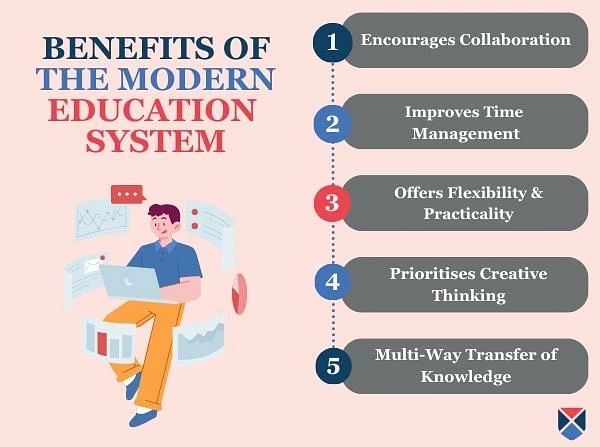
Modern education has several benefits compared to traditional educational methods. The benefits of modern education can be summed up as follows:
- Compared to conventional schooling, the contemporary educational system is more adaptable and practical. It makes it possible to take more courses online using different platforms. Additionally, real experts are consulted in addition to comments from books.
- In addition to helping you learn more, modern education also encourages interaction and socialisation.
- You learn to be creative, hardworking, and flexible through supplementary activities, leisure activities, theatre, and the crafts. This is one of the things that encourages students to enjoy going to school.
- The timed and supervised nature of classes and lectures in the modern school system motivates you to show up on time and maintain a constant demeanour.
Also Read: 5 Advantages And Disadvantages Of Online Education
Challenges Faced By Modern Education System
Numerous obstacles affect the modern educational system efficacy and capacity to respond to the changing demands of both students and society. The following is a list of typical issues that the contemporary educational system faces:
- Compliance: To achieve standard objectives or targets, students must follow a set of regulations, which may restrict their creativity and flexibility.
- Loss of Accountability: As a result of the growth in specialisation, the teachers feel less responsible for the student's overall development and do not give the necessary training and development for personality development.
- Insufficient Communication: Online courses are self-paced. The students find it difficult to establish friendships with their peers—hardly any face-to-face communication and social participation.
Modern Education System vs Traditional Education System
Out of numerous distinctions, a tabular differential of the modern education system vs traditional education system is given below for student's reference:
| Parameters | Modern Education System | Traditional Education System |
| Specificity | Subject-specific along with skill-based. | Subject-specific only |
| Flexibility | Flexible Schedules | Timetables Pattern |
| Communication Channel | Multi-way | One-way |
| Teaching Approach | Pragmatic approach | Classical approach |
| Objective | Practical and conceptual teaching | Theoretical sessions |
Also Check: 6 Coping Strategies For Student Mental Health
Modern Education or Traditional Education Which is Better?
There is a slight distinction between conventional education and modern education system. Any nation's or society's future depends on how capable its current generation is, so they must arm themselves with all pertinent knowledge on the most recent technologies, communication techniques, leadership qualities, etc.
- As a result, they will be prepared to deal with the issues of the present. One could contend that the current educational system is better.
- Modern systems were more successful because of the diversification of the subjects and activities. Contemporary educational practices adopted the conclusion that practical knowledge produces better results.
- Therefore, modern education was superior to traditional education. It develops the children's natural talent and abilities.